
The Ultimate Puglia Itinerary: 5, 7 & 10 Day Road Trip Guide
Italian summers are hard to beat. Over the years we’ve explored some of Italy’s most iconic destinations, including the Amalfi Coast and Cinque Terre, but Puglia completely surprised us. Its popularity has been rising in recent years, and after spending a week road tripping through the region, I understand exactly why. This Puglia itinerary is everything I learned.
Stretching along the heel of Italy’s boot, Puglia is home to whitewashed hill towns, fairytale trulli houses, dramatic limestone cliffs, turquoise beaches, and some of the most beautiful boutique hotels I’ve ever stayed in. One day you’re wandering the winding streets of Alberobello beneath its iconic trulli rooftops, the next you’re swimming in crystal clear water before ending the evening with dinner at a countryside masseria. It’s more relaxed than the Amalfi Coast, less crowded than Venice, and still feels wonderfully authentic in many places.
In this blog post, I’ll share the exact route I recommend after doing it myself: a one week road trip beginning in Bari and ending in the Salento, flying out of Brindisi, with stops in Matera, the Valle d’Itria, and some of the region’s most beautiful coastal towns. The core of this guide is the 7 day route I took, and at the end you’ll find my adapted 5 and 10 day versions.
Before we begin, one quick note about the pace: This itinerary is designed to help you experience the very best of Puglia in one week, so it does move fairly quickly. You won’t have time to explore every corner of every town, but that’s not the goal. Instead, this itinerary strikes a balance between sightseeing and slowing down, leaving plenty of time for leisurely lunches, afternoons by the pool, and long dinners that make an Italian summer so memorable.
This post contains affiliate links. If you make a purchase using one of these links, I may receive compensation at no extra cost to you. Thank you for supporting my business so I can create content like this for you.
The 7 Day Puglia Itinerary at a Glance
This itinerary begins in Bari, takes you to the ancient cave city of Matera, continues through the charming towns of the Valle d’Itria, and finishes in the beautiful Salento region of southern Puglia.
One thing you might notice is that Matera isn’t actually in Puglia. It belongs to the neighboring region of Basilicata. So why include it?
Simply put, it’s too incredible to skip. Matera is only about an hour’s drive from Bari, making it an easy addition to any Puglia road trip. With its ancient cave dwellings, dramatic viewpoints, and one of the most unique hotel experiences in Italy, I think it’s well worth spending a night there before continuing into Puglia.
Here’s how I recommend spending one week in the region:
Why This Itinerary Works
One of the biggest mistakes I see people make when planning a Puglia itinerary is changing hotels almost every night. It may look efficient on paper, but constantly packing, checking in and out, and driving between accommodations quickly eats into your vacation.
Instead, this itinerary uses just three bases: one night in Matera, four nights in the Valle d’Itria, and two nights in Lecce. From the valley, you’ll day trip to Alberobello, Locorotondo, Ostuni, Polignano a Mare, and Monopoli without ever repacking your bags, and Lecce puts Baroque streets and the whole Salento coast within easy reach for the final stretch. The result is a week that balances sightseeing with downtime instead of racing between towns.
One thing to note: all three bases are inland. Personally, I think staying at a countryside masseria is the quintessential Puglia experience and one I wouldn’t skip. But if being by the sea matters more to you, Monopoli makes an excellent alternative, as every day trip is just as easy from there. Or, for the best of both worlds, split the four valley nights between 2 nights at a masseria and 2 at a boutique hotel on the coast.
Know Before You Go
How to Get to Puglia
There are two main airports in Puglia: Bari (BRI) and Brindisi (BDS). For this itinerary, we flew into the larger Bari airport and out of Brindisi, which saves you a two hour backtrack north on your final day. If you have a round trip ticket into Bari, you’ll need to add about two hours of driving on your departure day from Lecce. Alternatively, you can swap the order to see Bari, Matera, Lecce, then the Valle d’Itria, so your trip ends an easy hour from Bari airport.
Check flight prices to Bari or Brindisi here.
Bari is also well connected by rail, so you can just as easily start this itinerary off a train from Rome or Naples. When we visited, the direct train from Rome to Bari (about 4 hours) was not available, which is why we flew.
Check train times and prices here.
Do You Need A Rental Car?
Yes. I highly recommend renting a car for this itinerary.
Puglia is a road trip region. Public transportation like trains connect the bigger towns, but the masserias, beaches, and small villages that make Puglia special are mostly only reachable by car. Having your own car also gives you the flexibility to stop at viewpoints, beaches, and charming villages along the way.
Driving in Puglia was not difficult. Outside of the larger cities, roads are generally well maintained. Just keep in mind that many historic centers have pedestrian only streets or ZTL (limited traffic) zones. The good news is that every destination in this itinerary has parking near the old towns, and I’ve noted the exact lots we used throughout this post.
I do always opt for a small car in Europe given narrow roads and tight parking spaces compared to the US.
I always book through DiscoverCars and filter for the reputable international companies like Hertz, Avis, and Enterprise. We used Avis this trip, picked the car up at Bari airport at 8 am, and everything went smoothly.
When to go
The best time to visit Puglia is from May through June and September through October, when you’ll enjoy warm weather, long daylight hours, and fewer crowds than peak summer.
July and August are beautiful but also the hottest and busiest months of the year, especially in popular destinations like Polignano a Mare and Alberobello. If you’re visiting during the summer months, plan to explore towns in the morning or evening and spend the hottest part of the day relaxing by the pool or at the beach.
For reference, we visited in early June.
✦ ✦ ✦
Day 1: Bari’s Old Town, Then Matera
Most visitors will arrive in Puglia via Bari, and rather than rushing straight to your hotel, I recommend spending a few hours exploring the city before making the drive to Matera. It’s the perfect introduction to southern Italy and lets you experience two incredible destinations on your first day. If you’re arriving on an early morning flight like we did (ours landed at 7:30 a.m.), you’ll essentially gain a bonus morning to explore Bari before continuing on.
Morning: Explore Bari Vecchia
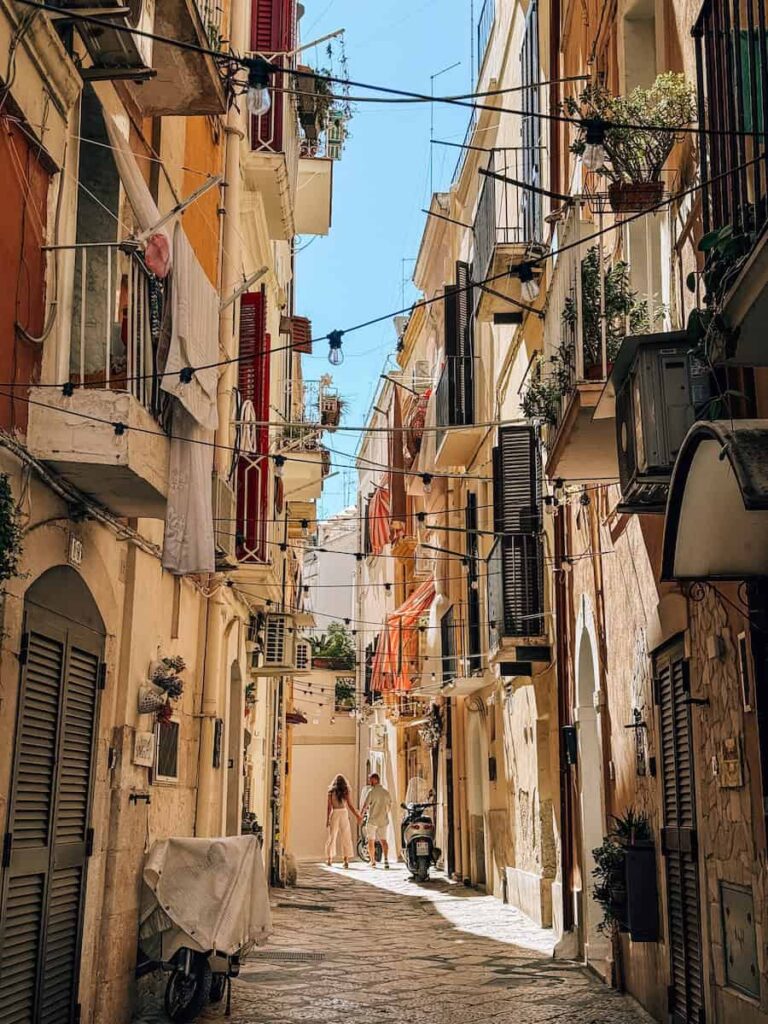
After landing at Bari Airport (BRI), pick up your rental car and drive about 15 minutes to Bari Vecchia, the city’s charming historic center. Much of the old town is pedestrian only, so you’ll need to park and walk in. We parked at Parcheggio Saba Porto, a covered parking lot about a 10 minute walk away, though there are some other lots around the port as well.
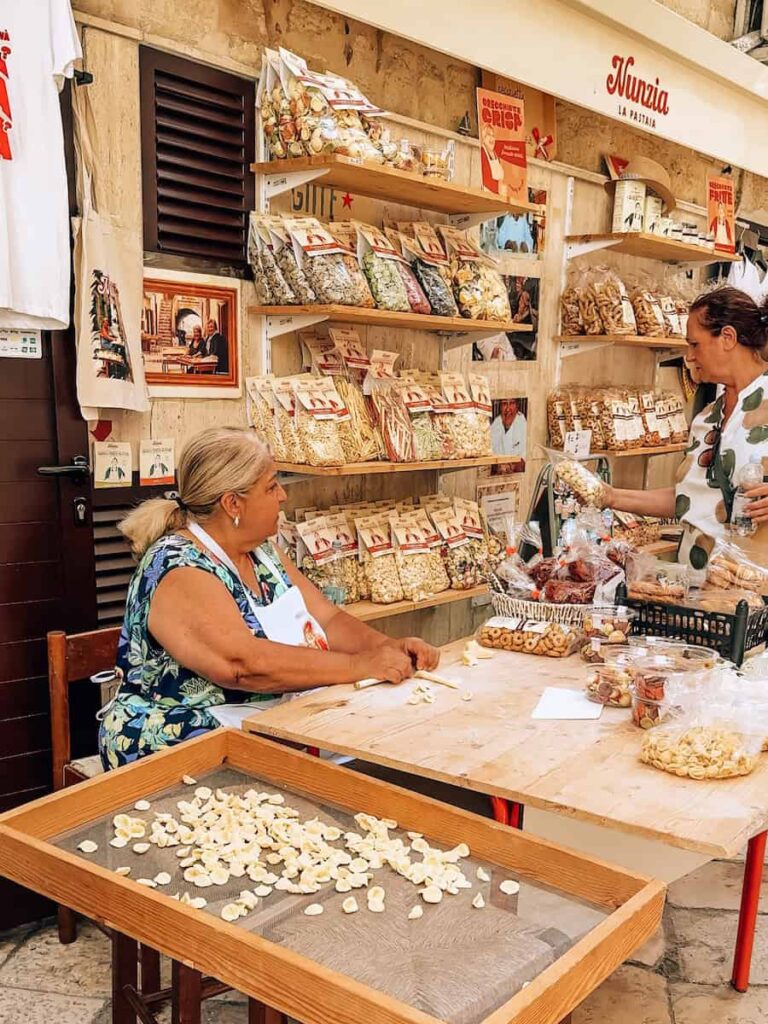
Bari Vecchia is wonderfully compact and can easily be explored in a couple of hours. Wander its maze of narrow alleys and admire the beautiful Basilica di San Nicola, the Romanesque church that holds the relics of Saint Nicholas, the original Santa Claus. And don’t miss Strada Arco Basso, better known as Strada delle Orecchiette, the street where local nonnas sit outside their homes hand rolling fresh orecchiette pasta, one of Bari’s most beloved traditions. Buy a bag or two to show some appreciation.
If you have time, grab a snack before leaving the city. We picked up sandwiches at La Salumeria le Delizie di Andrea, a little cold cut shop. We quickly learned that we should eat as much burrata and stracciatella as possible in Puglia, because it’ll be the best you’ve ever had. Alternatively, Panificio Santa Rita is famous for its focaccia barese and is well worth a stop, though you’ll almost always find a line.
Arriving in Matera
From Bari, it’s about a one hour drive to Matera.
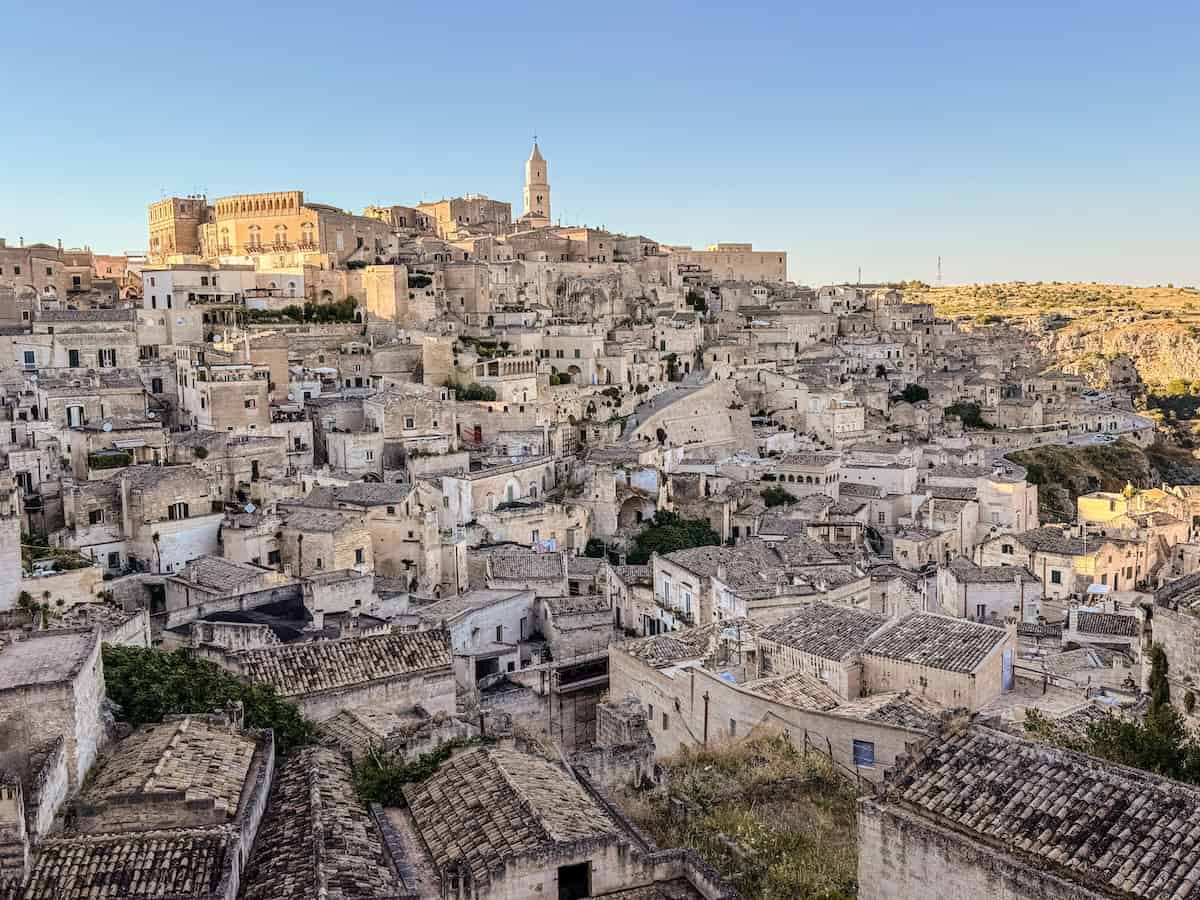
Although Matera is technically in the neighboring region of Basilicata rather than Puglia, I think it’s an essential stop on any first time Puglia itinerary. Its location makes it an easy detour from Bari, and spending a night here lets you experience one of the most extraordinary cities in Italy. Considered one of the oldest continuously inhabited cities in the world, Matera is famous for its Sassi, ancient districts of cave dwellings carved into the rock, which were named a UNESCO World Heritage Site in 1993.
Cars aren’t permitted in much of the Sassi, so you’ll need to park outside the historic center. Most cave hotels can arrange transportation from the nearby lots, which makes arrival surprisingly straightforward. We parked at Parking Sant’Isidoro, which costs 20 euros a night. We paid through our hotel, which had pre-arranged a pickup from the lot for us.
We checked into Sant’Angelo Luxury Resort, a hotel spread through restored cave dwellings right by Piazza San Pietro Caveoso, and I can’t overstate the feeling of sleeping inside the Sassi. More on where to stay below.
If you’re hungry when you arrive, I recommend lunch at Trattoria del Caveoso. Definitely try the pasta with peperone crusco, or cruschi peppers, a local specialty of dried, crispy sweet peppers that shatter like a crisp.
Exploring Matera
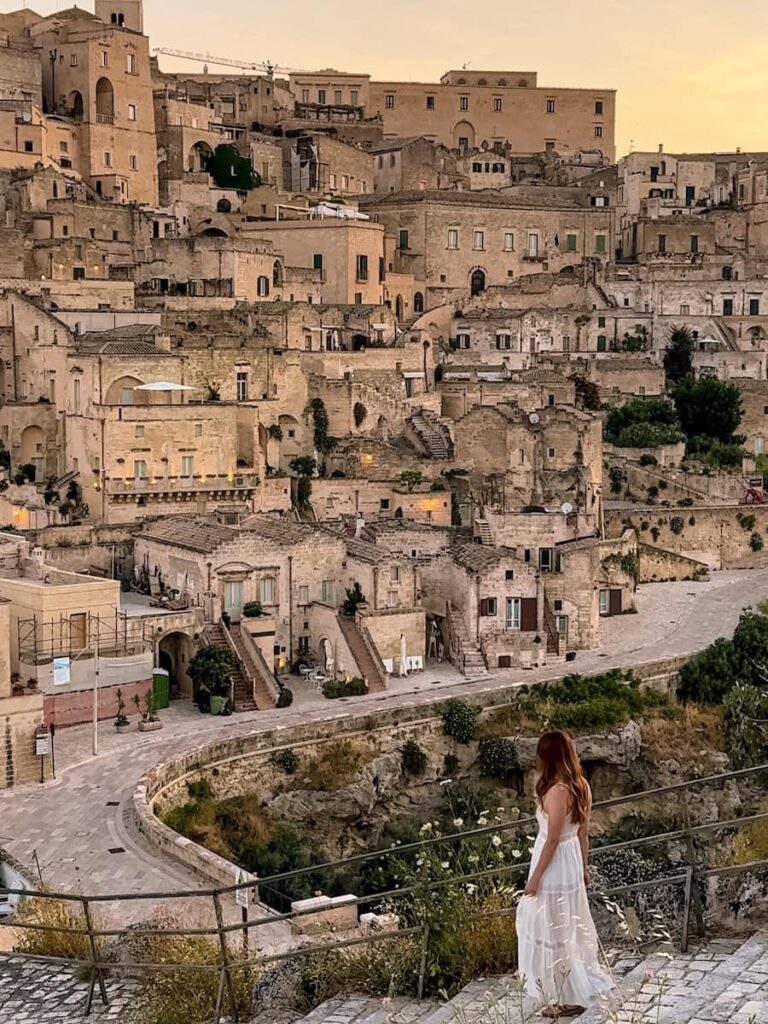
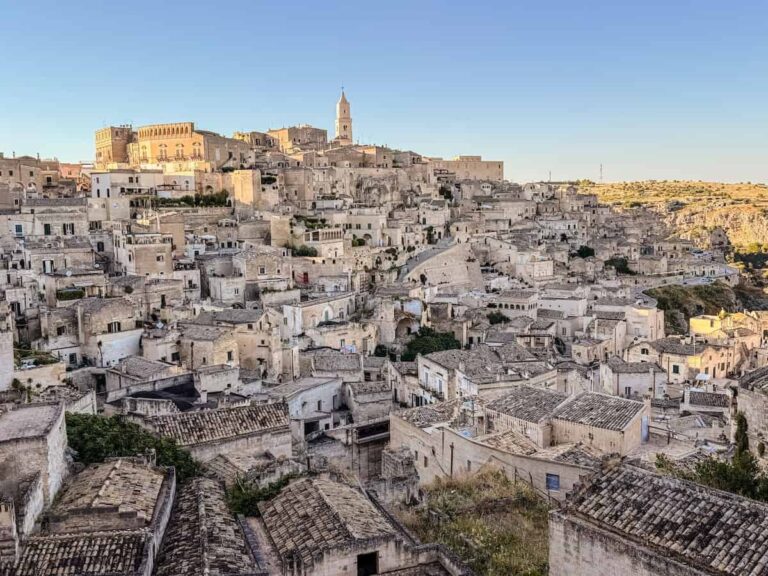
Spend the rest of the afternoon simply wandering the Sassi di Matera. There really isn’t a strict route to follow: the magic of Matera comes from getting lost among its ancient stone alleyways, staircases, cave churches, and breathtaking viewpoints. This is one of the oldest continuously inhabited cities on earth, and every staircase and rooftop opens onto another jaw-dropping view of stacked cave houses.
To orient yourself: the Sassi are made up of two districts. Sasso Barisano, to the northwest, is the more restored half, home to most of the cave hotels and restaurants. Sasso Caveoso, to the southeast, is the rawer, more ancient side, where many cave dwellings sit much as they were left. Between them rises the Civita, the rocky spur crowned by the Matera Cathedral, with lovely views over both Sassi from its terrace.
A few spots not to miss as you wander: Piazza San Pietro Caveoso, the only square in the Sassi that opens directly onto the ravine; the rock Church of Santa Maria di Idris, carved into the massive outcrop above it; Casa Grotta di Vico Solitario, a preserved cave dwelling that shows how families lived here until the 1950s; and Piazzetta Pascoli, the viewpoint for the classic postcard panorama of the Sassi.
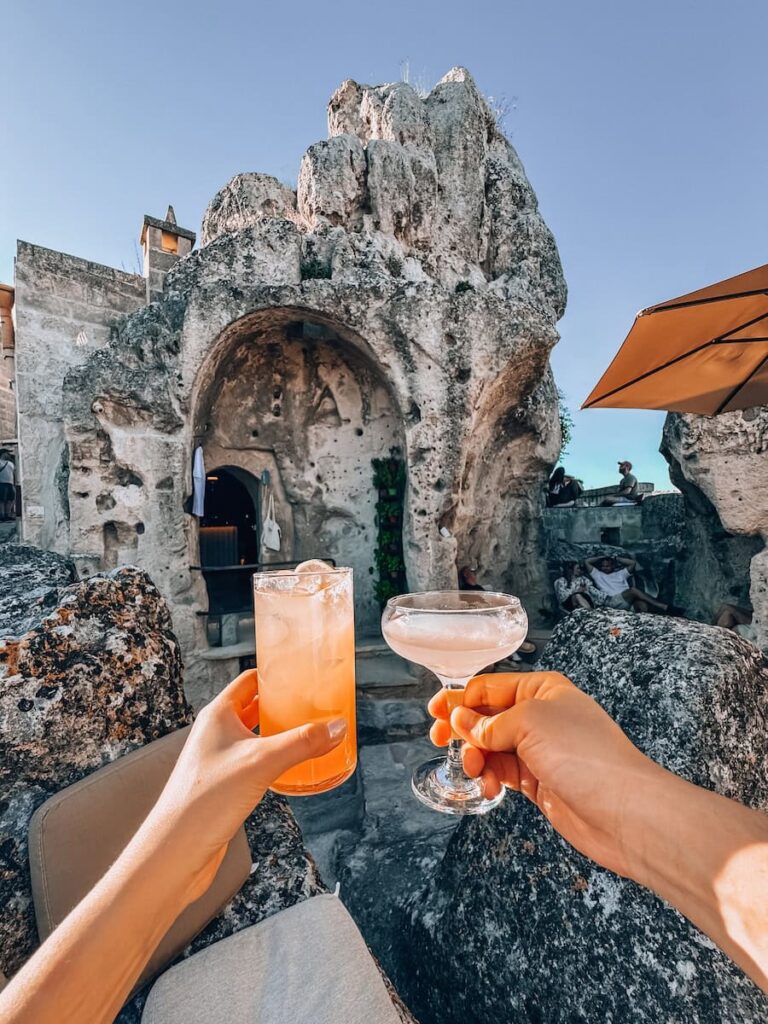
Definitely stop by Zipa Café, one of the coolest bars I’ve ever stepped into, or rather onto, since it spills outdoors across the rocks.
For dinner, we went to Baccanti, an elegant cave restaurant for a spectacular meal.
Where to Stay in Matera
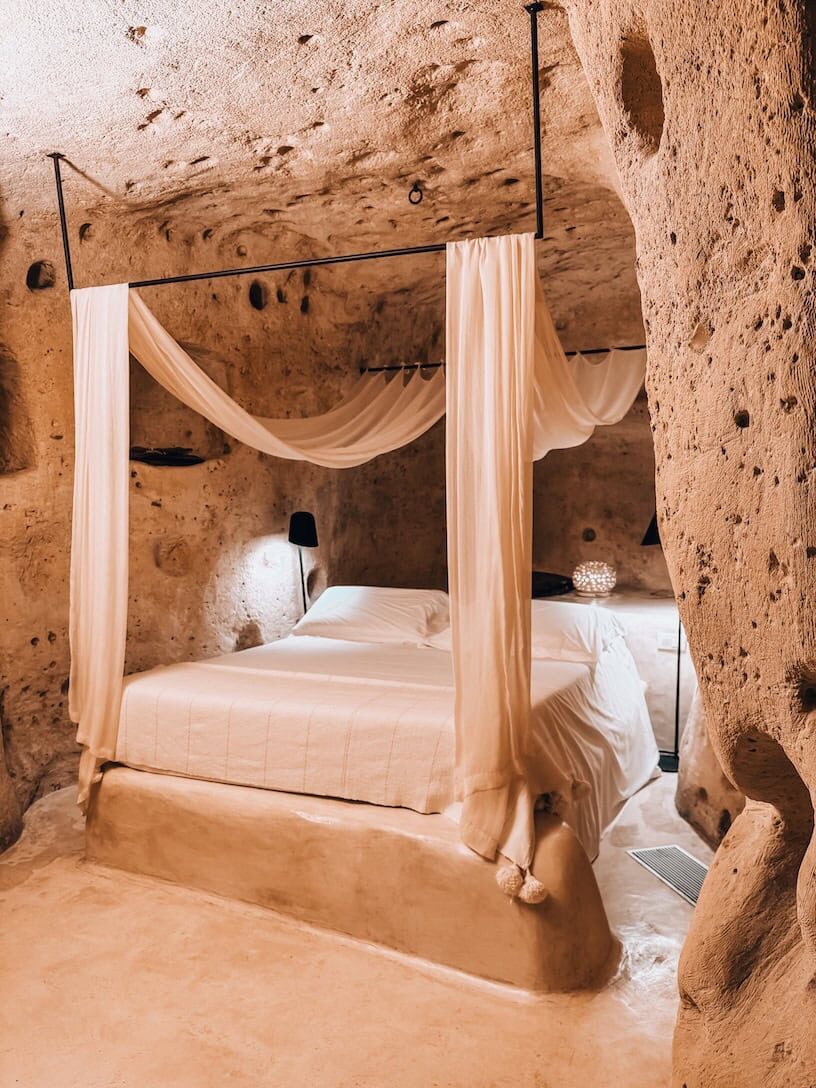
I highly recommend staying in a cave hotel. Sleeping within the Sassi is one of the most unique hotel experiences in Italy and completely changes the feel of visiting Matera after the day trippers have gone home.
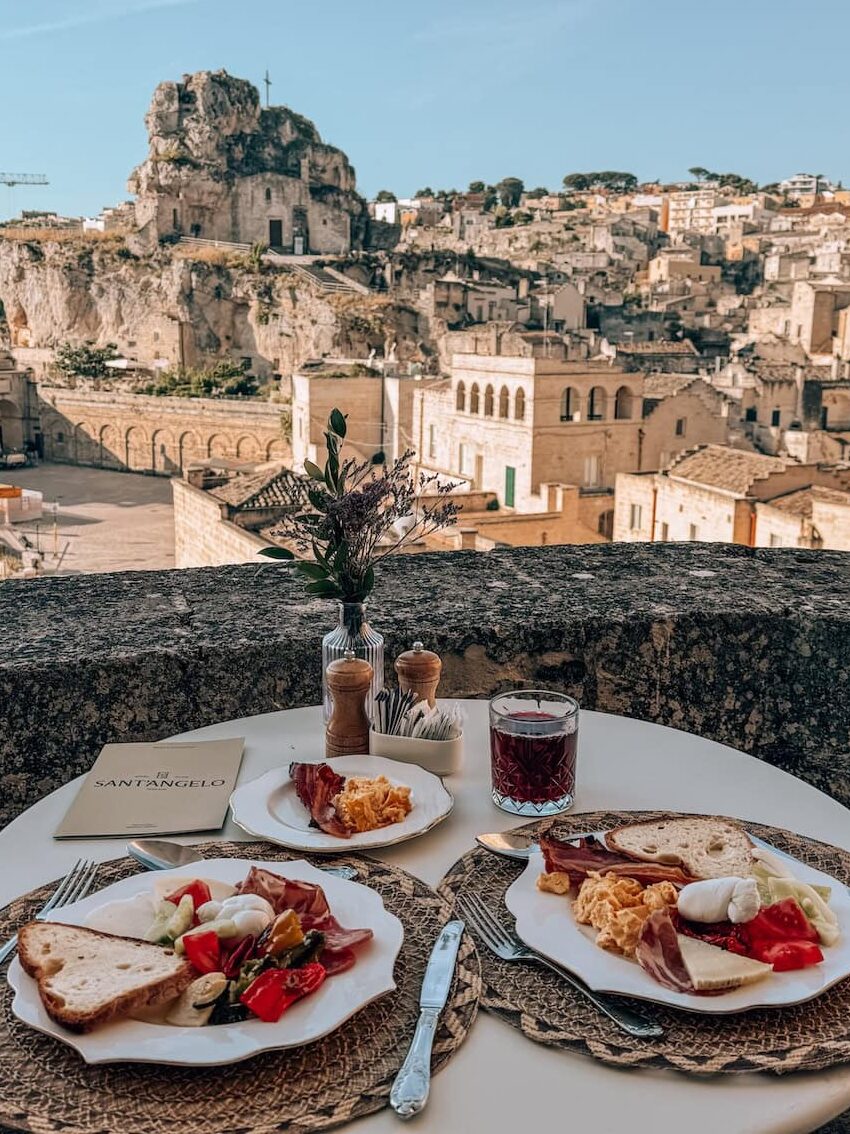
Sant’Angelo Luxury Resort (where I stayed): restored cave rooms right next to Piazza San Pietro Caveoso with gorgeous evening views over the Sassi. Breakfast the next morning was amazing, with views of Church of Saint Mary of Idris.
Sextantio Le Grotte della Civita: the most iconic cave hotel in Matera, candlelit and wonderfully raw, with freestanding tubs inside thousand-year-old caves.
Aquatio Cave Luxury Hotel & Spa: a five star option near the cathedral with an indoor cave pool and underground spa, ideal if you want cave atmosphere with full modern amenities.
Palazzo degli Abati: a boutique stay in the Sasso Barisano next to the rock church of San Pietro Barisano, with rooms carved into the rock or set in the 18th century palazzo, and a rooftop terrace with sweeping views over the Sassi.
Day 2: Matera at Sunrise, Settle Into the Valle d’Itria
Sunrise in the Sassi
Good morning! Wake up early this morning to see Matera in the soft morning light. With nobody else on the stone staircases, it feels like stepping back thousands of years. Watching the light slowly illuminate the honey colored stone buildings was one of my favorite moments of the entire trip.
If you’re staying within the Sassi, you can simply step outside your hotel and begin exploring. The viewpoints that were bustling the afternoon before are wonderfully quiet in the early morning, making it the perfect time for photos.
Back at the hotel, enjoy a leisurely breakfast before checking out. At Sant’Angelo Luxury Resort, breakfast was served on a terrace overlooking the Sassi, and it was, no exaggeration, one of the most incredible breakfast views of my life.
Drive to the Valle d’Itria & Check in
From Matera, it’s about a 90 minute drive to the Valle d’Itria, a picturesque region known for its rolling countryside, olive groves, whitewashed villages, and iconic trulli houses. This is where I would base myself for 4 nights (or split 2 nights here with 2 nights in Monopoli as mentioned above).
Rather than staying in one of the towns themselves, I recommend booking a countryside masseria or trullo. A masseria is a traditional farmhouse or agricultural estate, which in the past served as residences and working farms. Today, many of these masserias have been transformed into boutique luxury hotels. Trulli (the plural of trullo) are traditional Apulian dry stone huts with distinctive cone roofs, native to the Valle d’Itria.
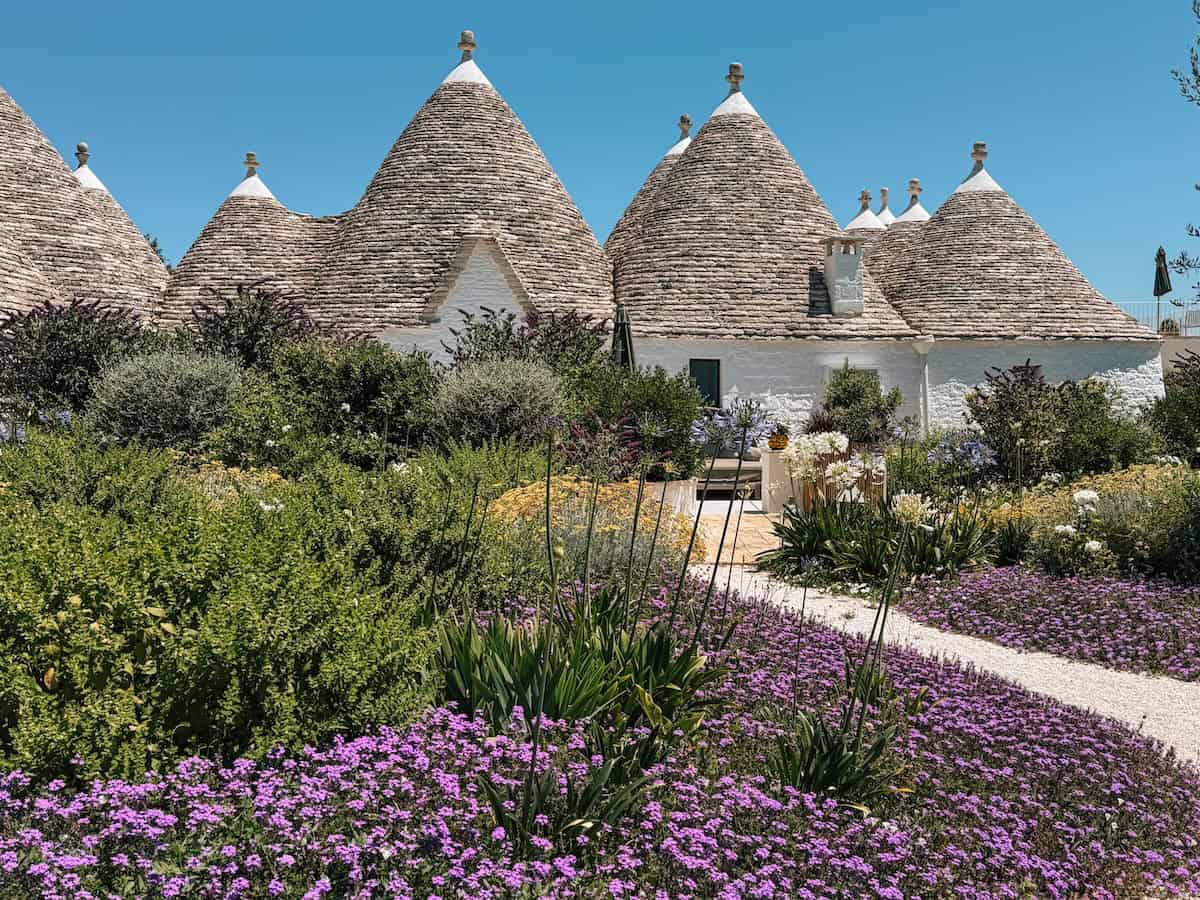
We stayed at Trulli Damari, a beautifully restored collection of luxury trulli just outside Locorotondo. After a 5 year renovation period, this incredible property just opened in 2025, and features beautiful trullo suites.
*We were hosted to stay at Trulli Damari, but all opinions written are my own.
Slow Down & Enjoy Your Masseria
Take the afternoon to settle in and enjoy everything that makes staying in the Apulian countryside so special. Go for a swim, unwind with an aperitivo by the pool, or simply relax beneath the olive trees. Personally, I think a countryside masseria stay is one of the defining experiences of a trip to Puglia, and it’s well worth slowing down to appreciate it.
In the evening, stay in for dinner: some of the most incredible meals in Puglia are served at the masserias themselves. Ours coincided with a special dinner at Trulli Damari featuring traditional folk dancers and live music, which made staying in an easy decision.
Alternatively, consider driving into the town of Martina Franca for dinner. Often overlooked in favor of Alberobello and Ostuni, it’s one of the Valle d’Itria’s most elegant towns, with beautiful Baroque architecture, lively piazzas, and excellent restaurants. We didn’t make it there ourselves, but it’s high on my list for a future trip.
Where to Stay in the Valle d’Itria
Trulli Damari (where I stayed): a five star resort set in six hectares of gardens and orchards between Locorotondo and Martina Franca, with rooms inside beautifully restored trulli, a picturesque pool overlooking the valley, and immaculately kept grounds. Breakfast every morning was a highlight.
Ottolire Resort: an intimate 13 room boutique resort just outside Locorotondo, with restored trulli hidden in a private oak forest, a spa with steam room and hot tub, and a pool overlooking the valley.
Borgo Canonica: an entire restored trulli hamlet on a secluded hillside near Cisternino, where every suite sits beneath its own stone cone. Peaceful, stylish, and one of the most unique stays in the valley.
Masseria Torre Maizza: Rocco Forte’s five star Puglian outpost near the coast at Savelletri, about 30 minutes from the heart of the valley, with a golf course, beach club, and full grand-hotel service. The super luxe splurge of the list.
Masseria Il Frantoio: a historic working olive farm near Ostuni, beloved for its award-winning organic olive oil and legendary multi-course farm dinners. The romantic, old-world choice.
Day 3: Alberobello and Cisternino
Today we’ll visit two beautiful villages of the Valle d’Itria.
Morning in Alberobello
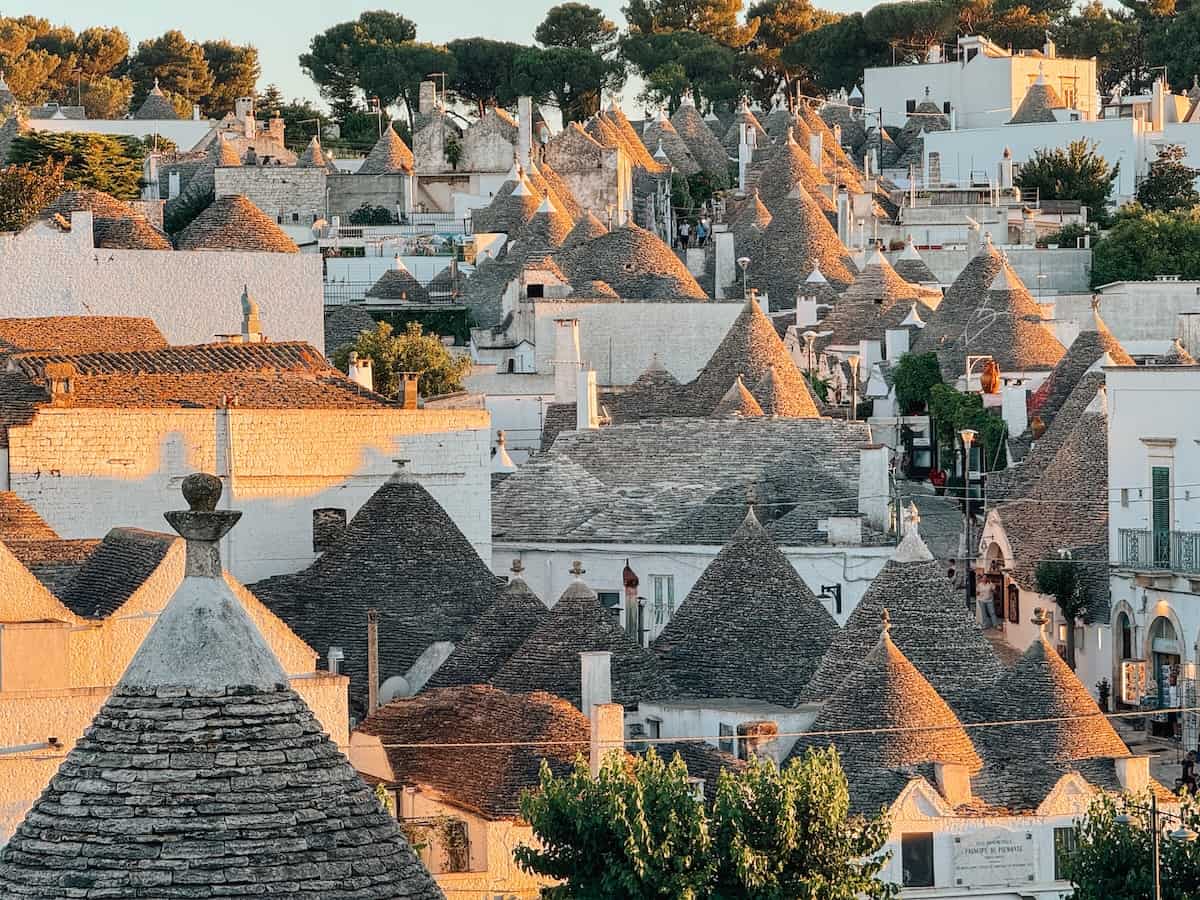
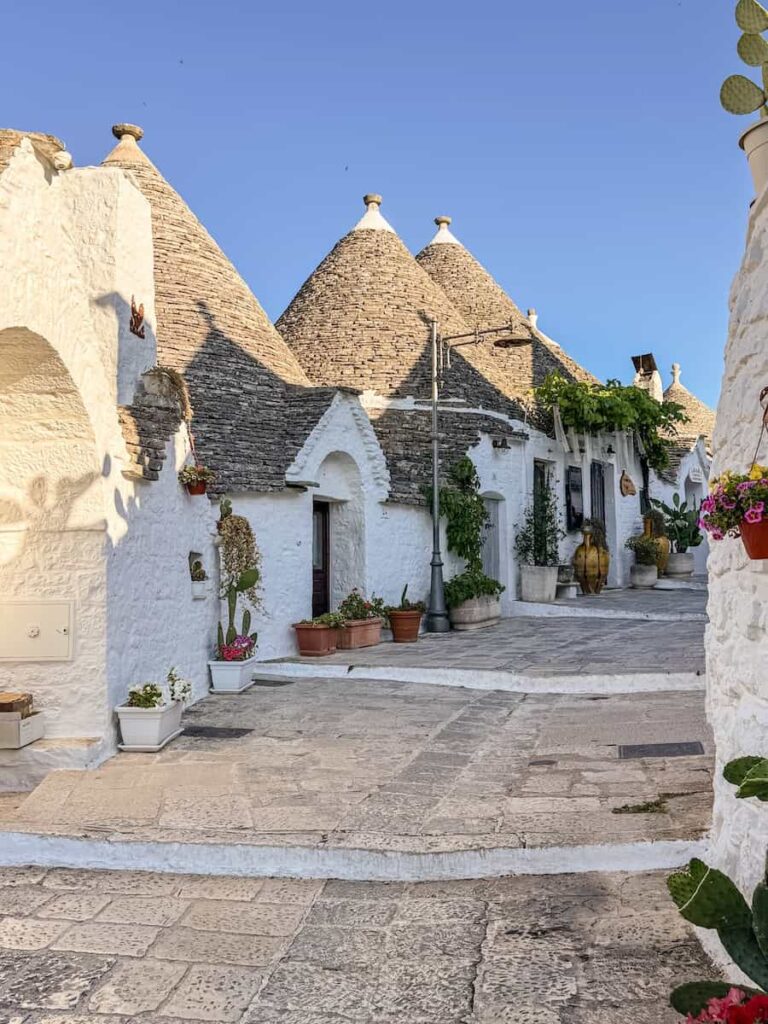
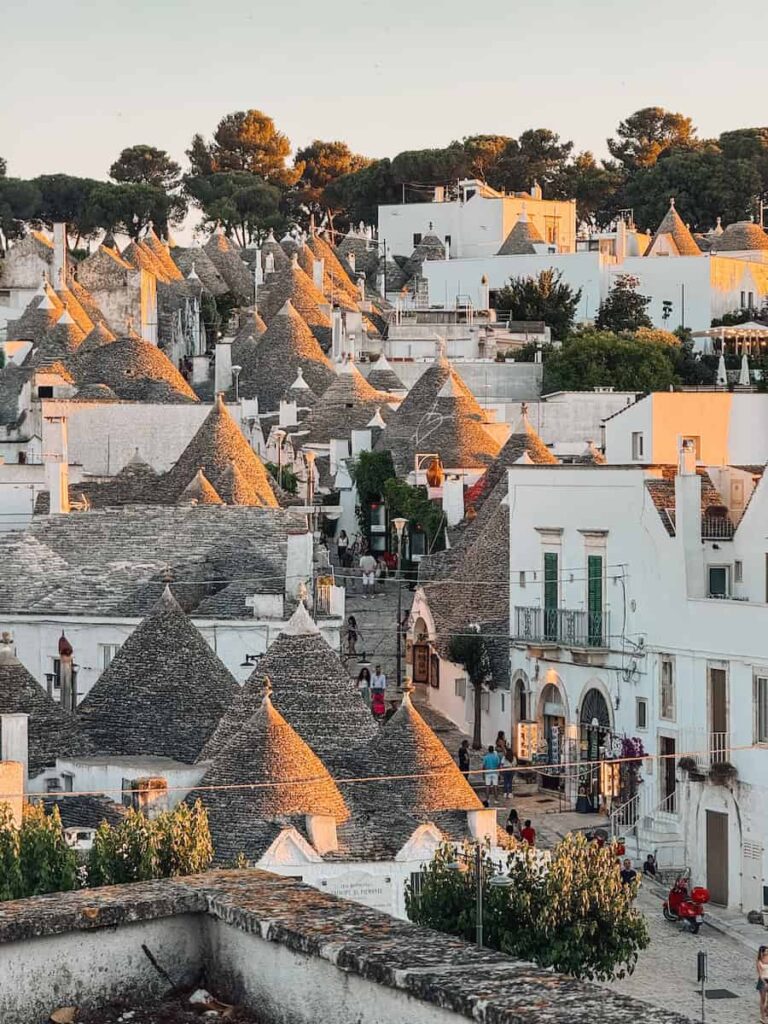
Get an early start and drive to Alberobello, probably the most famous place in Puglia, with over 1,500 trulli creating a streetscape that feels almost unreal. It’s undeniably touristy, but it’s absolutely worth seeing, and going early is how you beat the worst of it: arrive before the tour buses around 9:30 and you’ll have the cone-roofed lanes nearly to yourselves. (We visited in the evening, the other quiet window, and the golden light on the white stone was beautiful too, so if your day flows better in reverse, it works)
The main trulli district is Rione Monti, where the sloping lanes are lined with shops, restaurants, and restored trulli. It’s also the busiest part of town. For a quieter and more residential feel, cross over to Aia Piccola, where many trulli are still used as homes.
In Rione Monti, some of the trullo shops have terraces with panoramic views over the rooftops. These shops typically allow access to the terrace if you purchase something, and it can be something small, like a magnet. For the classic postcard panorama, the Belvedere Santa Lucia viewpoint which is a free terrace is also a short walk away.
For lunch, try to reserve a table at Trattoria Casa Amatulli, which was our first choice but was fully booked when we arrived. We ate at Ristorante Trullo D’Oro instead and had a very good meal inside an actual trullo. But learn from our mistake: if there’s a restaurant you have your heart set on in Alberobello, reserve it days in advance.
Afternoon Pool Break
After lunch, you could head straight to the next town, but with the long summer days and intense midday heat, I highly recommend returning to your hotel for a few relaxing hours by the pool.
Not only is it a welcome break from sightseeing, but it also gives you a chance to enjoy your masseria rather than treating it as simply a place to sleep. Some of my favorite memories from Puglia were the quiet afternoons spent unwinding by the pool before heading back out for the evening.
By the time golden hour arrives, you’ll feel refreshed and ready to explore again
Evening in Cisternino
As the temperature begins to cool, head to Cisternino, one of the prettiest villages in the Valle d’Itria.
We parked at Parcheggio comunale which had free parking spots and was a short walk to the center. I did notice a bunch of metered street parking on our way, however, so if you want to park closer for a small fee, that is an option.
The centro storico (historic center) of Cisternino is very compact, making it perfect for an evening stroll. Wander through its narrow lanes and lively little piazzas before settling in for dinner.
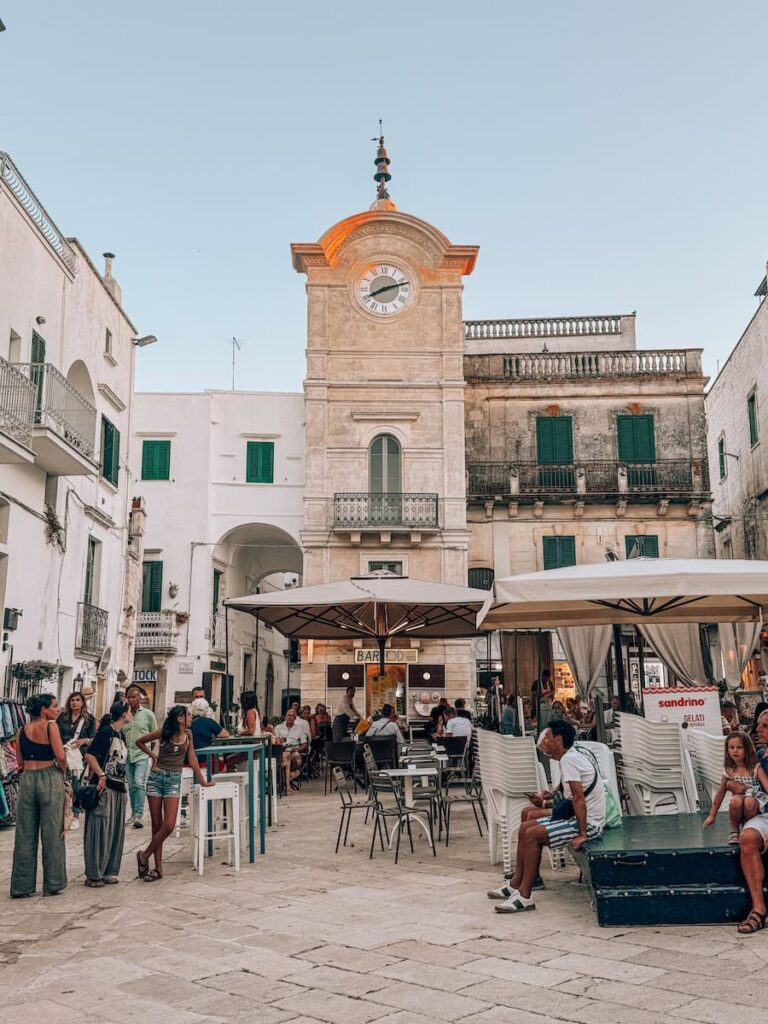
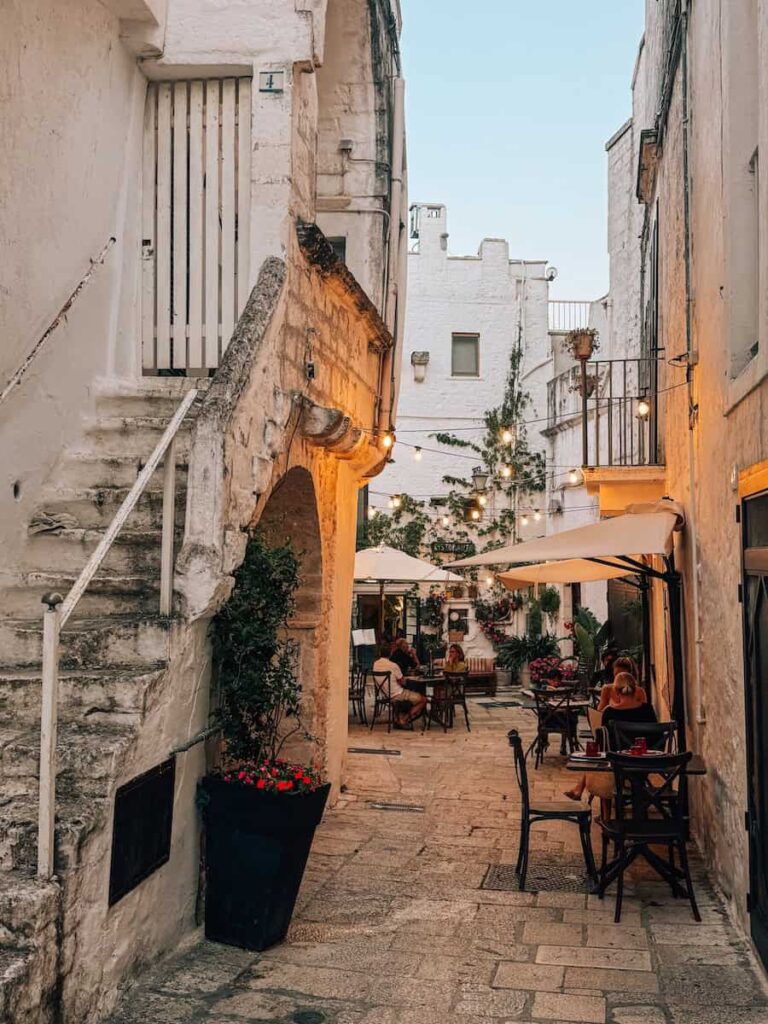
Cisternino is especially famous for its fornelli pronti, traditional butcher shops where you choose fresh cuts of meat that are grilled to order and served at tables.
We had dinner at Zio Pietro, and it was such a unique experience. If you’ve never experienced a butcher restaurant before, this is the perfect place to try one. They don’t take reservations so you may have to line up like we did, but it moved relatively quickly. Zio Pietro is only open for dinner.
Here you choose your meat straight from the butcher’s counter, and they’ll guide you to a table in the restaurant. The team will grill your meat and bring it to your table, and in the meantime you can order sides and drinks at the table. Make sure to order the bombette, the little pork rolls stuffed with cheese that are the Valle d’Itria’s signature.
After dinner, enjoy one last stroll through the historic center before returning to your hotel.
Day 4: Polignano a Mare and Monopoli
Today you head to the Adriatic coast, about 30-45 minutes from the Itria Valley (Valle d’Itria).
Morning in Polignano a Mare
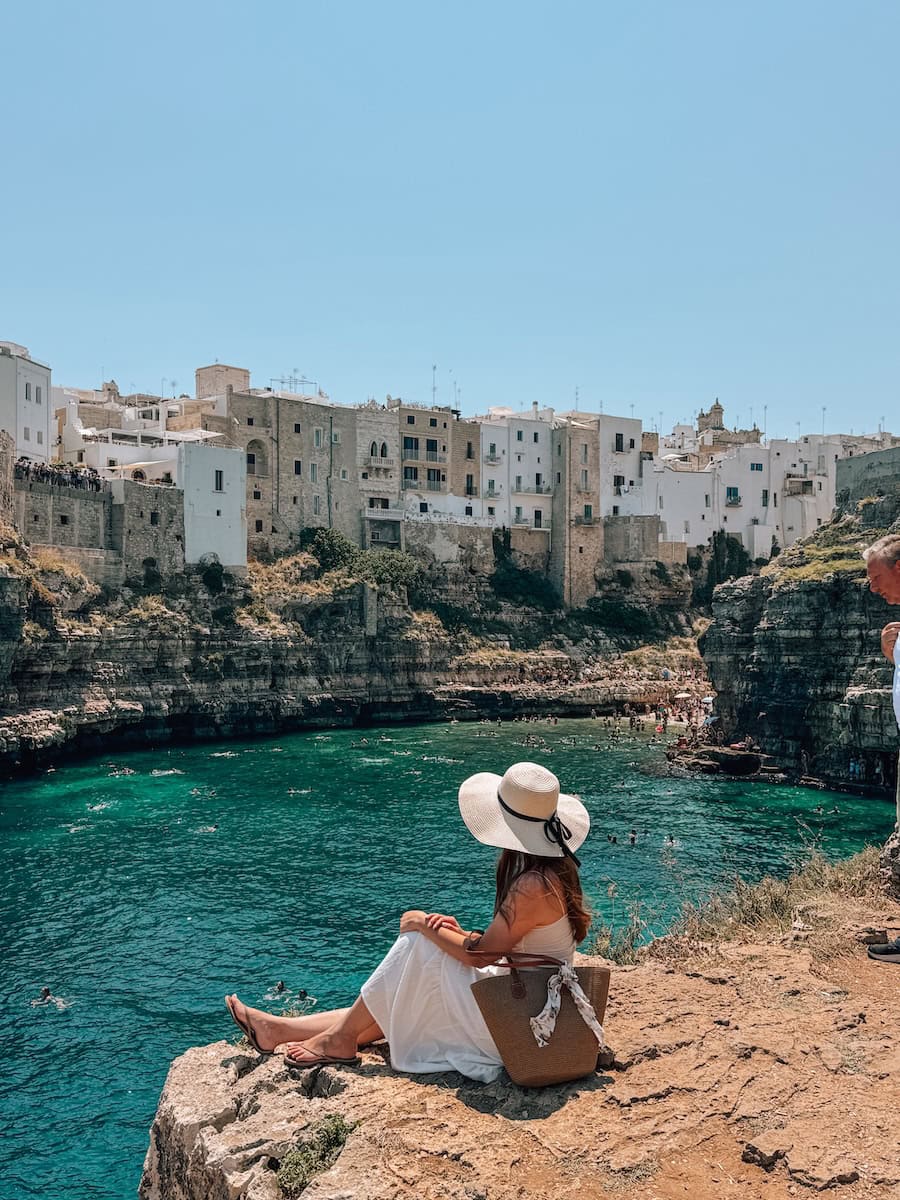
After breakfast, drive to Polignano a Mare, one of the most photographed towns in Puglia. From our hotel near Locorotondo it was about a 30 minute drive, and we parked at one of the parking lots nearby. Perched dramatically atop limestone cliffs overlooking the Adriatic Sea, it’s famous for its breathtaking viewpoints, whitewashed streets, and the crystal clear waters of Lama Monachile.
Polignano a Mare was by far the most crowded town we visited during our trip.
Spend a few hours wandering the historic centre, stopping at the various terraces overlooking the sea, browsing the small shops, and walking down to Lama Monachile Beach, the iconic pebble beach nestled between towering cliffs. It is a public beach so there aren’t any chairs or service, and you’ll just have to find a spot to throw down your towel. If you plan on spending time swimming at Lama Monachile Beach, I recommend going early in the morning.
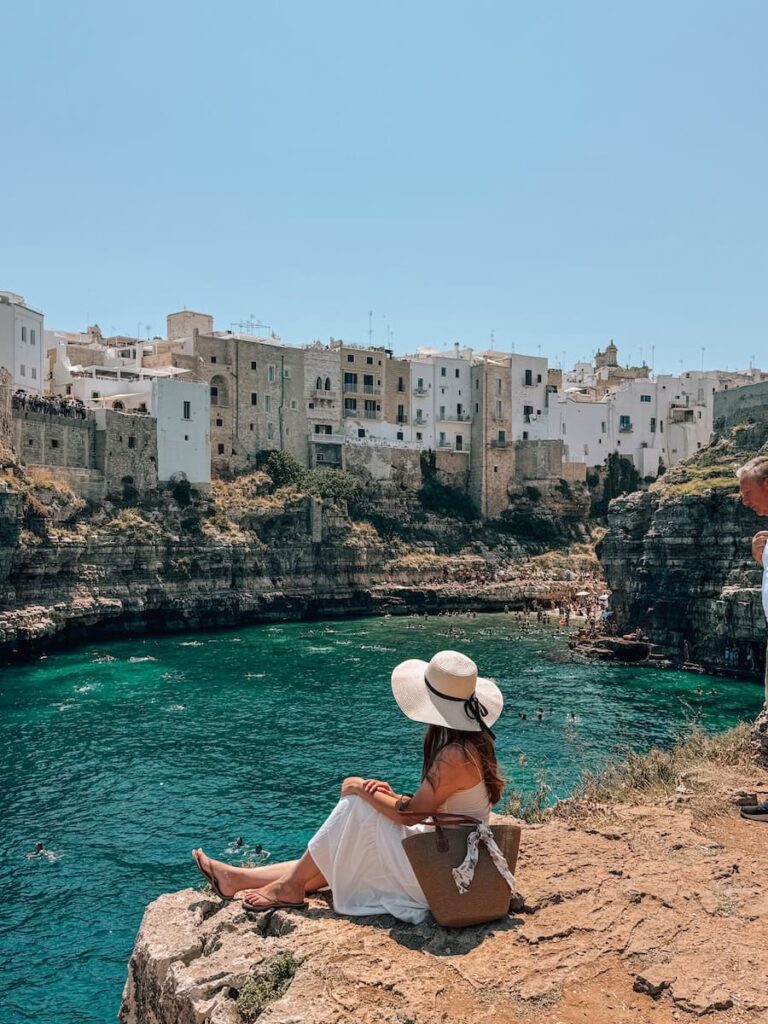
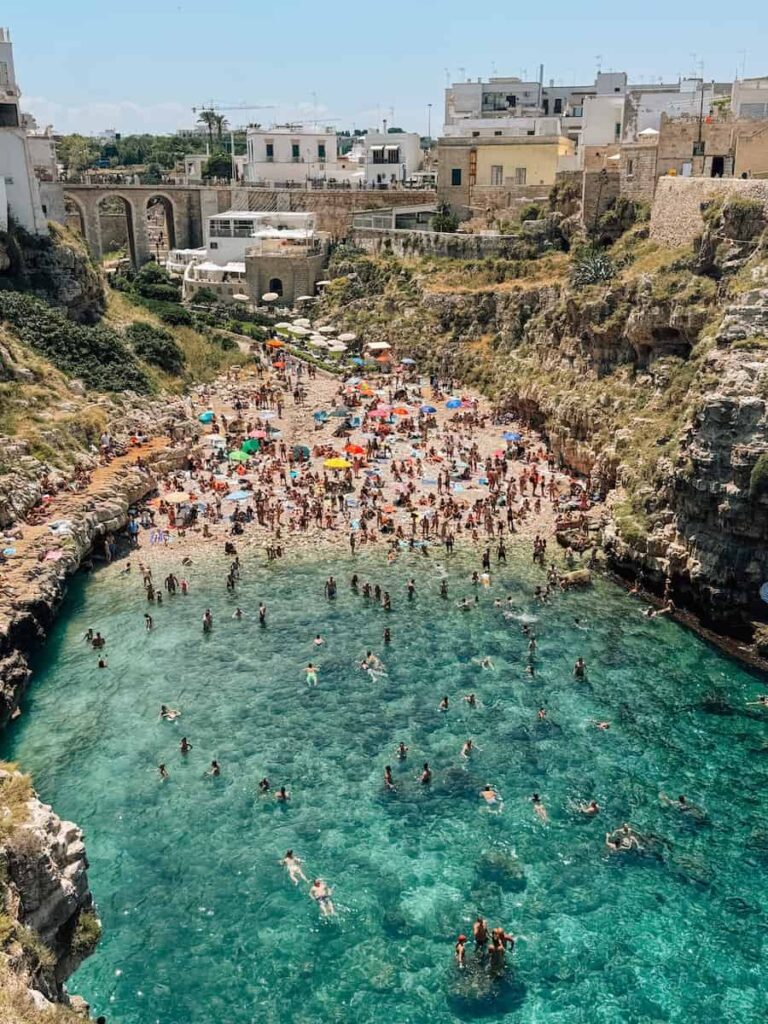
Some of the best views in Polignano a Mare are from the Flat Stone, a giant rock platform a few steps down from the historic center, along with Lama Monachile Lookout and Punto Panoramico.
For lunch, choose one of the restaurants with sea views before continuing to your next stop.
If you like boat tours, this would be a great place to do one! The sea caves along Polignano’s coast are best seen from the water.
Afternoon in Monopoli
After lunch in Polignano, make the short drive (15 minutes) down the coast to Monopoli for the afternoon.
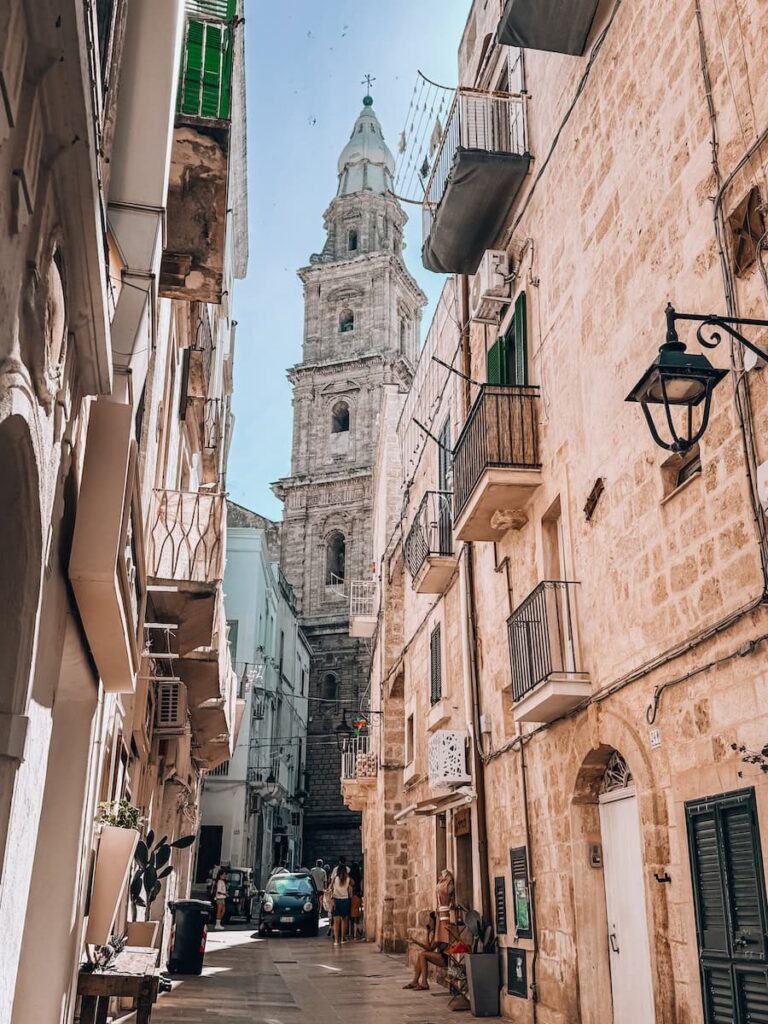
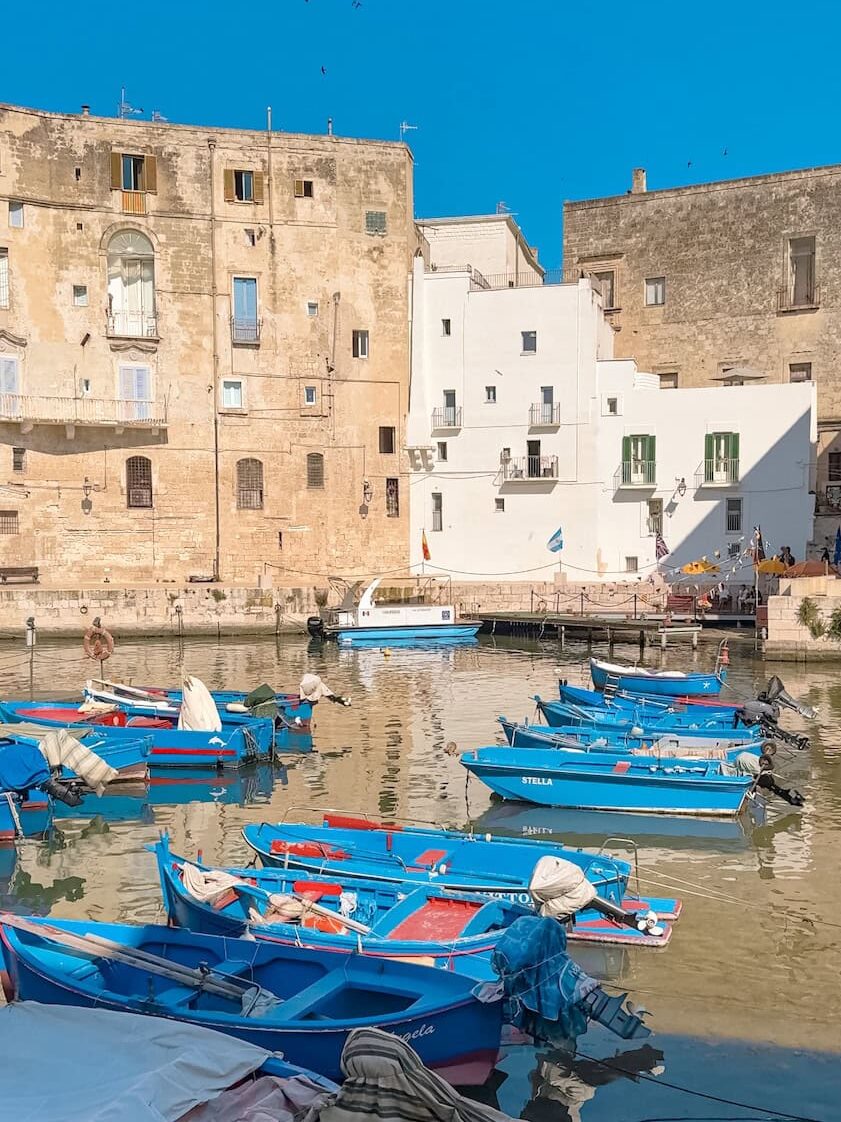
Monopoli was one of the pleasant surprises of our week: a working port town with bright-colored fishing boats, a lovely old town, and far fewer tourists than its famous neighbor. Despite how close these two main cities are, Monopoli felt so much more relaxed.
There is also a beach right in the city of Monopoli called Cala Porta Vecchia, set against a backdrop of medieval defense walls. Unfortunately, it was closed for construction when we visited, so we did not get to experience it on our trip.
We dined at Il Guazzetto in the historic center, which served some of the most incredible seafood dishes of our whole trip.
Day 5: Locorotondo and Ostuni
Your last full day in the Valle d’Itria pairs two beautiful towns and dinner with unbeatable views.
Morning in Locorotondo
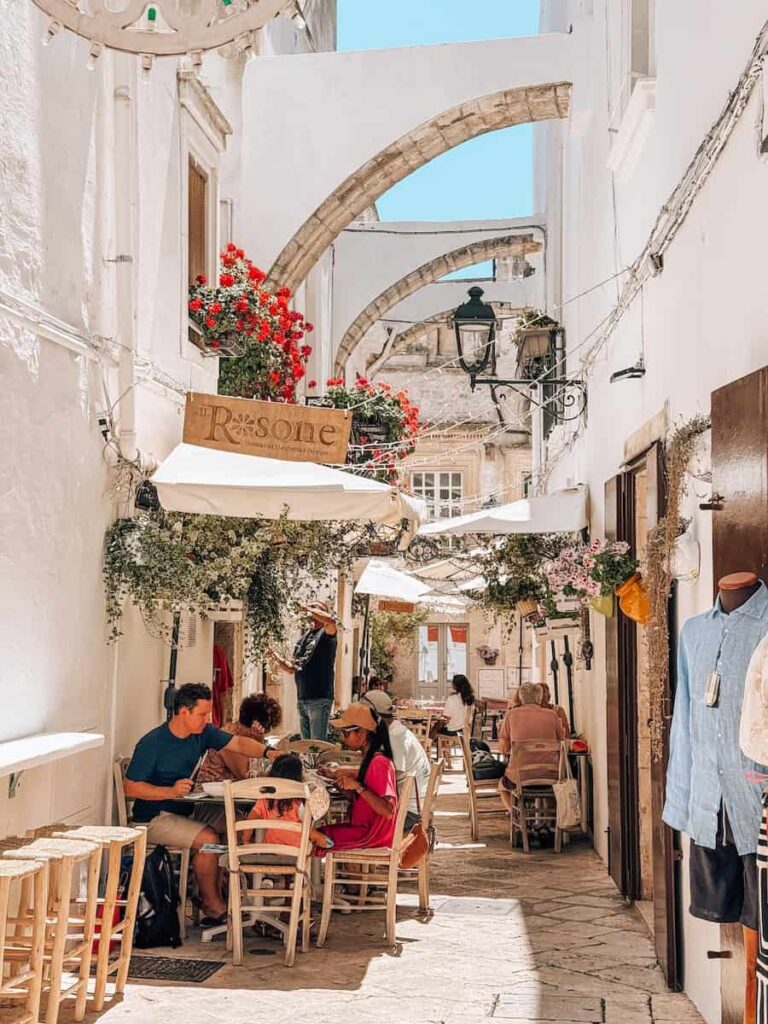
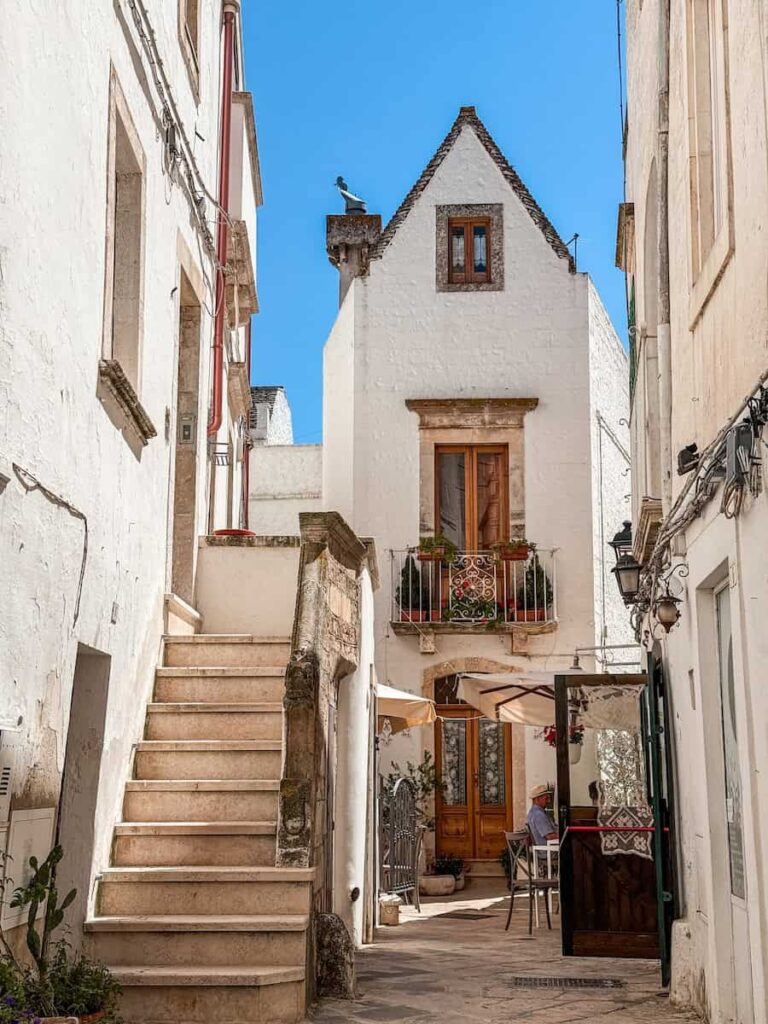
After breakfast at your hotel, drive to Locorotondo, a small hilltop town known for its circular historic center, whitewashed lanes, and balconies overflowing with flowers. Locorotondo is considered one of the “Borghi piu belli d’Italia” or the most beautiful villages in Italy, and it definitely deserves that recognition.
We parked in a metered street parking space near the historic center. Rather than risk accidentally parking in a restricted area, I opted for a paid spot for peace of mind. It was well worth the small cost for the convenience.
Locorotondo is compact and easy to explore on foot. Wander through the narrow streets, peek into charming shops, and stop at the viewpoints along the edge of town for sweeping views across the Valle d’Itria countryside.
For lunch, I highly recommend U’ Curdunn, where we had one of our favorite meals of the trip. Chef Roberto serves beautifully prepared Puglian dishes in a charming stone dining room. We didn’t have a reservation, but it may be a good idea if you’re visiting in peak summer season.
Afternoon Break
After exploring Locorotondo, return to your hotel for another relaxing afternoon by the pool. By now you’ll probably notice the rhythm of this itinerary, and that’s intentional. Rather than trying to see every town back to back, these slower afternoons give you time to enjoy your hotel and escape the midday heat before heading out again in the evening.
Evening in Ostuni
In the afternoon, drive to Ostuni, a dazzling hilltop town whose whitewashed buildings can be seen from miles away. It’s known as La Città Bianca, the White City.
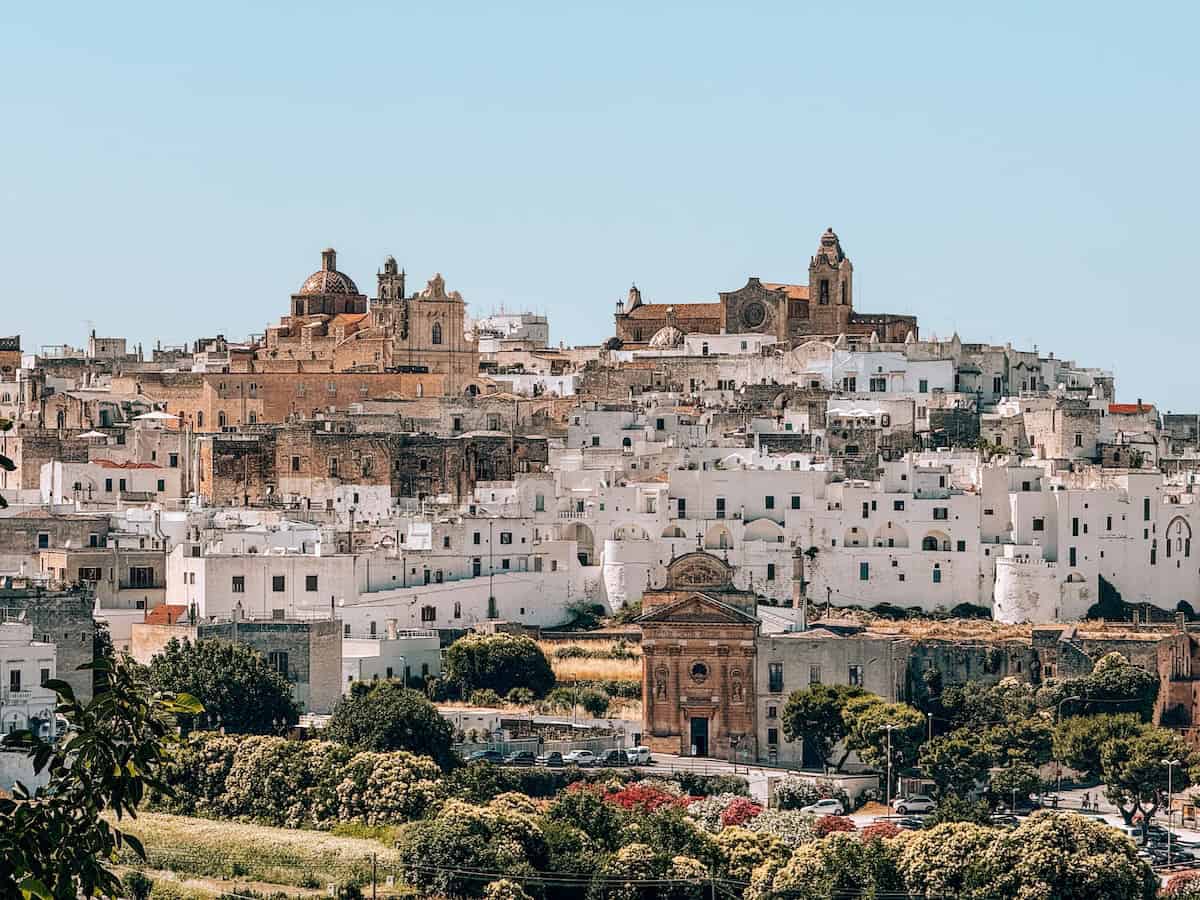
Since much of the historic center is pedestrian only, park just outside the old town and spend a few hours exploring the city center on foot.
Ostuni is an incredibly picturesque city, and every alley and archway is a photo spot.
Tuk tuk tours have become very popular here, and although we didn’t do one, I wish we had. Ostuni is steep, winding, and confusing, given its labyrinth of narrow streets. We got lost a few times, and couldn’t keep track of which corners we had already seen. Add in the blazing summer heat, I would opt for a tuk tuk tour next time.
As you make your way uphill, you’ll eventually reach the Cathedral of Santa Maria Assunta, whose beautiful Gothic façade is one of the town’s highlights. Make sure to take in views from the ramparts, as they stretch all the way to the Adriatic.
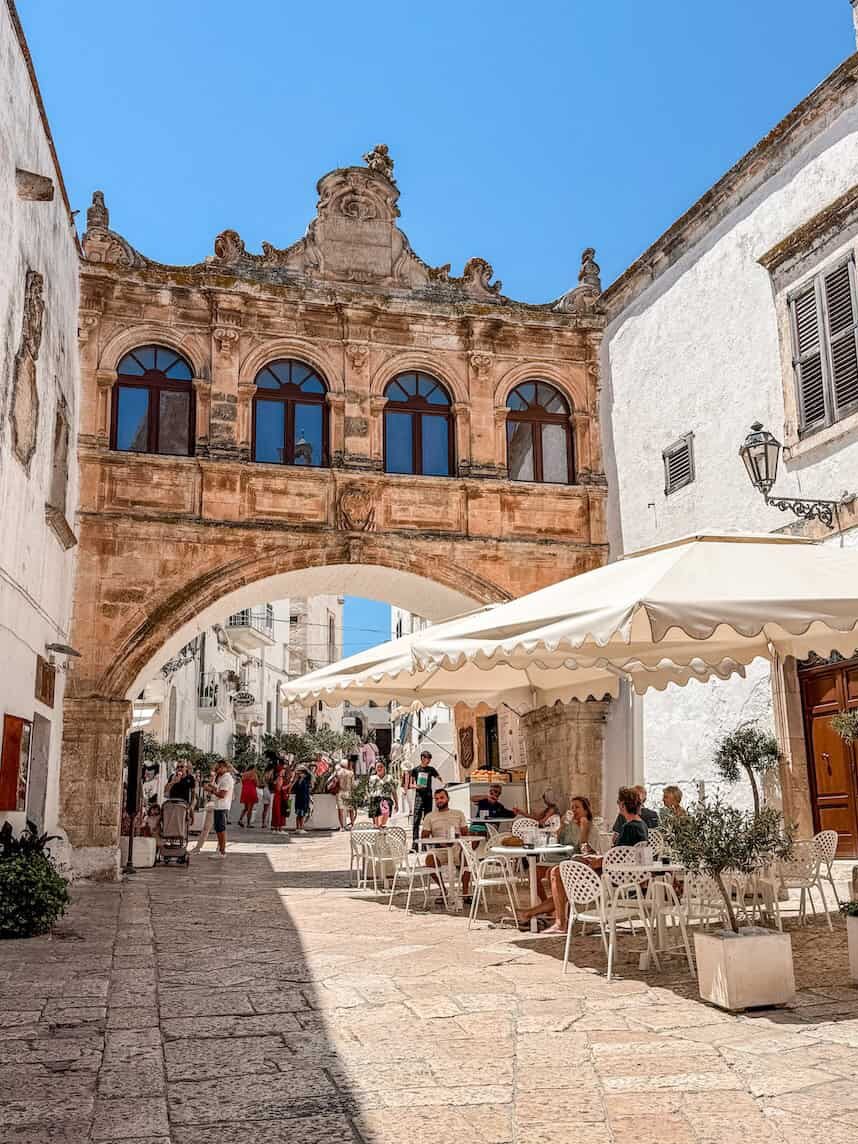
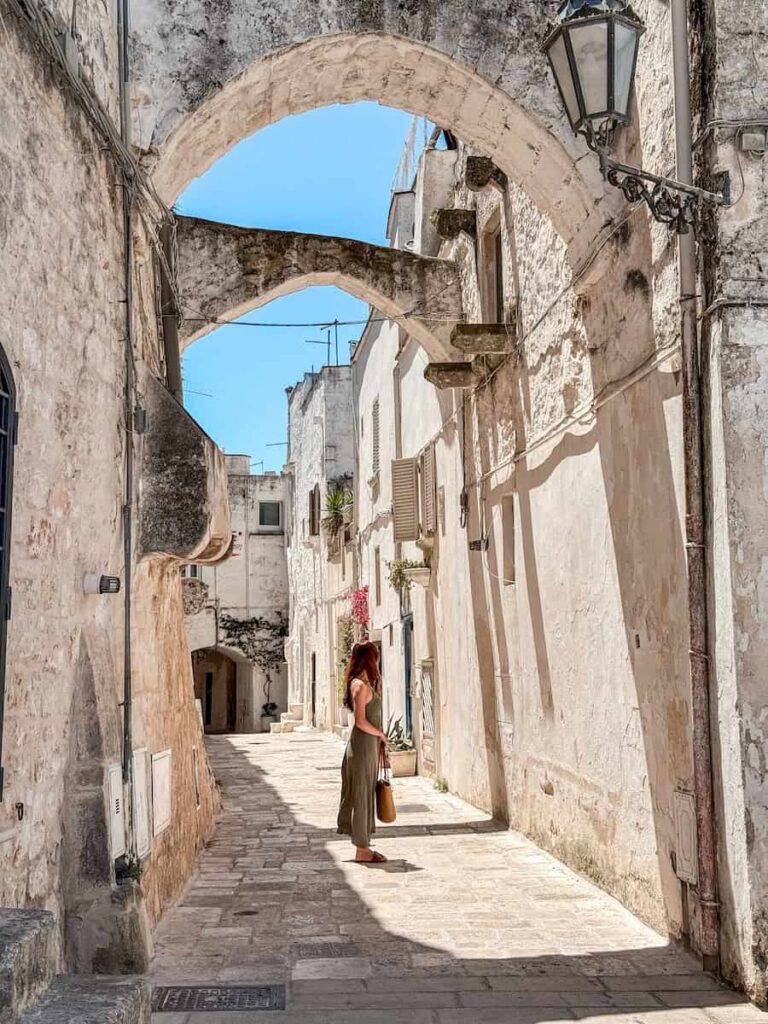
Stay for dinner in the old town, and book ahead in summer. For pre or post dinner drinks, head to Borgo Antico Bistrot, which you’ve probably already seen all over Instagram. I passed by during the day and it didn’t have the same magic, but in the evening the vibes are unmatched, which is exactly why I recommend saving Ostuni for night.
Then drive back to your masseria for one last valley night.
Day 6: Lecce, the Florence of the South
Today you’ll say goodbye to the Valle d’Itria and make the drive south to Lecce, the cultural heart of the Salento. Known for its ornate Baroque architecture, elegant piazzas, and lively café culture, Lecce is called the Florence of the South and feels noticeably different from the whitewashed hill towns you’ve explored over the past few days.
Check in to your hotel, before setting out to explore this incredible city. See below for where to stay.
The city is a fever dream of honey-colored baroque. It is nicknamed “City of 100 Churches” but in reality there are more than a hundred. The Basilica di Santa Croce is the most famous church, with its intricately carved facade, the Duomo and its theatrical piazza, a Roman amphitheater sitting casually in the middle of the main square. Popular churches including the Santa Croce require tickets to see the interiors.
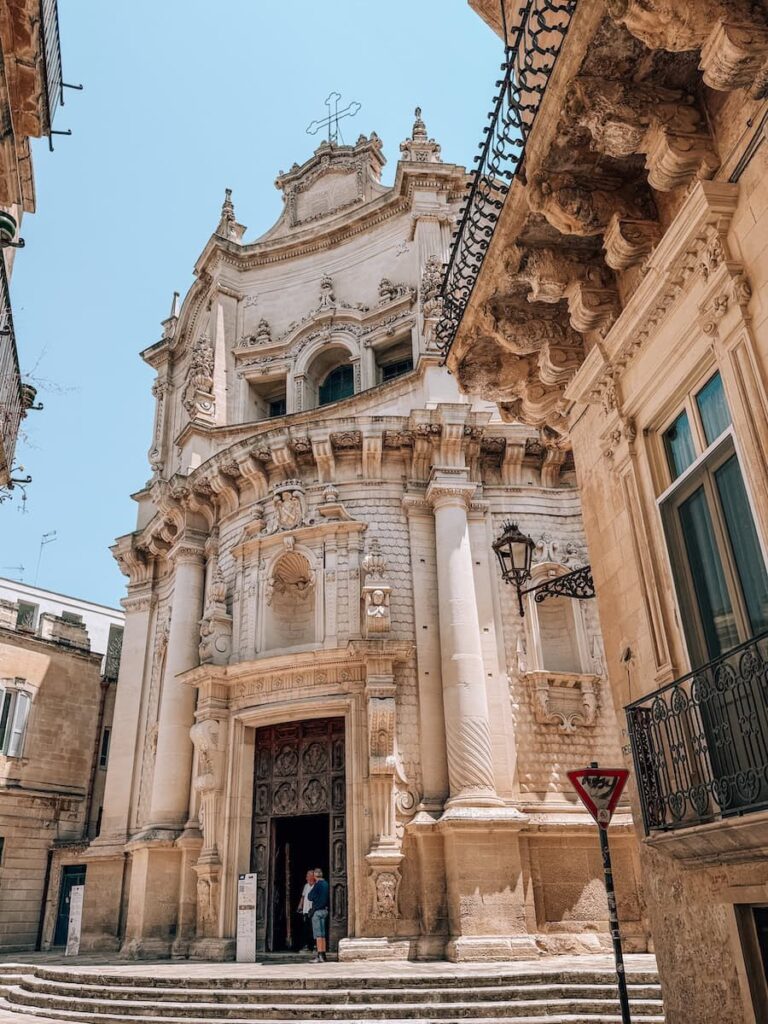
Between churches, check out the artisan workshops the city is known for, especially the cartapesta (papier-mâché) studios that have been making religious figures here for centuries.
When in Lecce, make sure to try Caffè Leccese, an espresso poured over ice with almond syrup. This sweetened coffee was just what we needed while exploring Lecce on a hot summer day. You should also try a pasticciotto, a warm shortcrust pastry filled with custard. We had ours at Cafe Alvino.
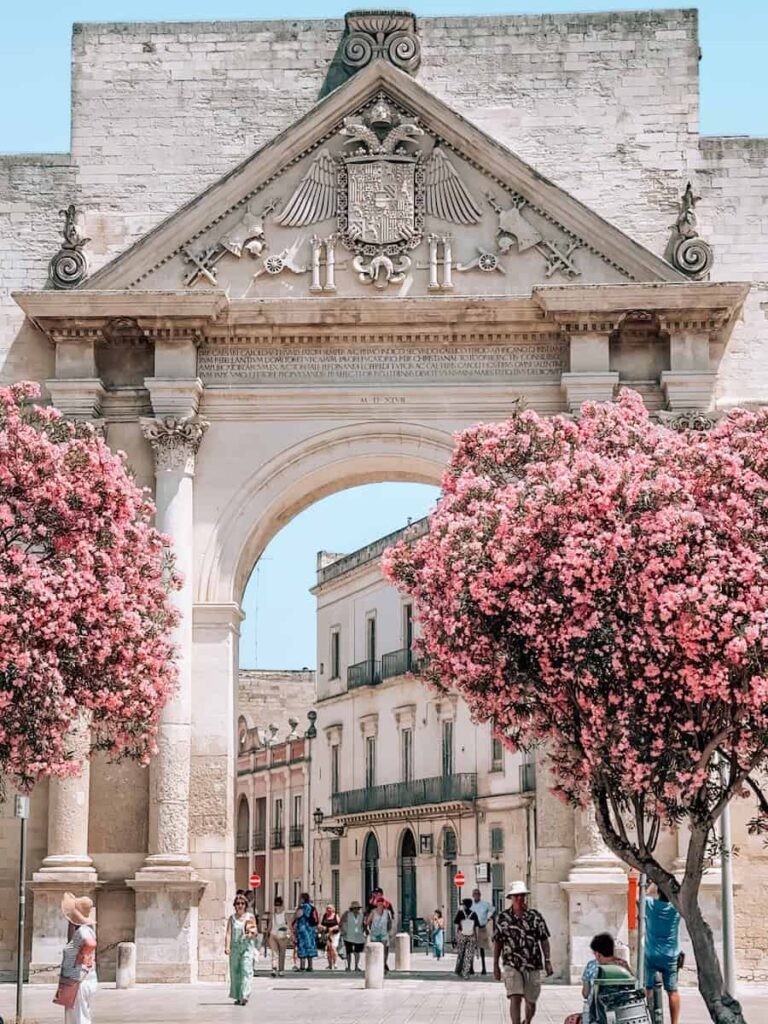
Lecce has three majestic historical entrance gates: Porta Napoli, Porta Rudiae, and Porta San Biagio. My favorite was Porta Napoli, as it was perfectly framed by the oleander trees in full bloom at the time of our visit. You can see these pink flowers in full bloom from late spring through summer.
Finish the day with dinner at one of the many restaurants tucked throughout the historic center before enjoying an evening stroll through the beautifully illuminated streets.
Where to Stay in Lecce and the Salento
We actually stayed at a masseria near Otranto for our last two nights, and while I loved it, my honest advice for this itinerary is to base in Lecce instead: you can walk to dinner in one of Italy’s most beautiful cities, and everything on days 6 and 7 is an easy drive. Whether you’re leaving out of Brindisi or Bari, Lecce will be closer.
Palazzo Bozzi Corso: an elegant 18th century palazzo stay with soaring ceilings, from the same family as La Fiermontina.
Patria Palace Hotel: a classic grand hotel right by Piazza Sant’Oronzo, with views of the Basilica di Santa Croce from the rooftop.
Palazzo de Noha – a nine room boutique gem tucked into the lanes beside the Duomo, where rough-hewn stone vaults meet contemporary Italian design, with Roman ruins visible through glass floors and a lovely terrace with a pool.
Masseria Muntibianchi AgriResort (where I stayed): if you prefer to end the trip in the countryside, this peaceful masseria among centuries-old olive groves near Otranto has two pools, and a lovely farm-to-table restaurant. I’d happily go back, just know you’ll be driving a bit more to everywhere.
Day 7: Beach Day, Then a Farewell in Otranto
You can’t come to the Salento and skip its beautiful beaches, so the last full day is for the sea.
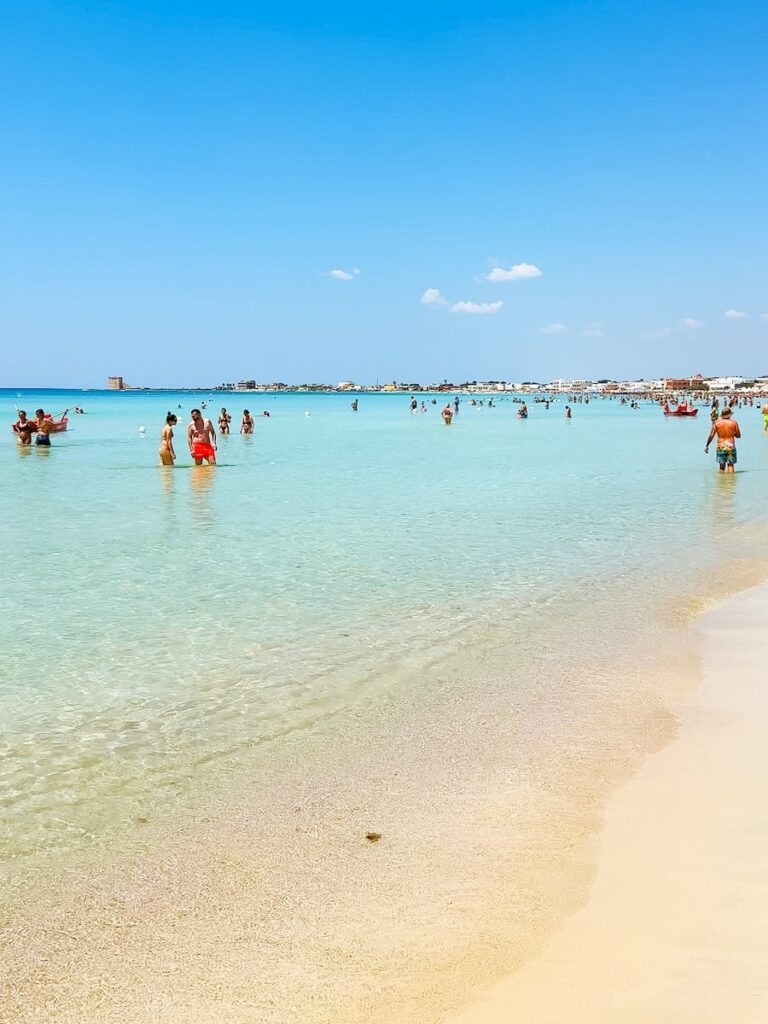
The Salento peninsula is the tip of Italy’s heel, wedged between two different seas. The Ionian sea, on the western side, is where you’ll find long sandy beaches and shallow, calm, impossibly turquoise water, the stretch that earns the “Maldives of Italy” nickname. The Adriatic coast, on the eastern side, is wilder and more dramatic: rocky coves, sea caves, cliffs, and deep blue water made for jumping in.
There are countless beaches and swimming spots along both coasts, so don’t feel bound to my exact stops. Pick one or two that suit your taste for the day, whether that’s a full day on a daybed or hopping between rocky coves. Below is how we spent ours.
Morning: Relax at Porto Cesareo or Punta Prosciutto
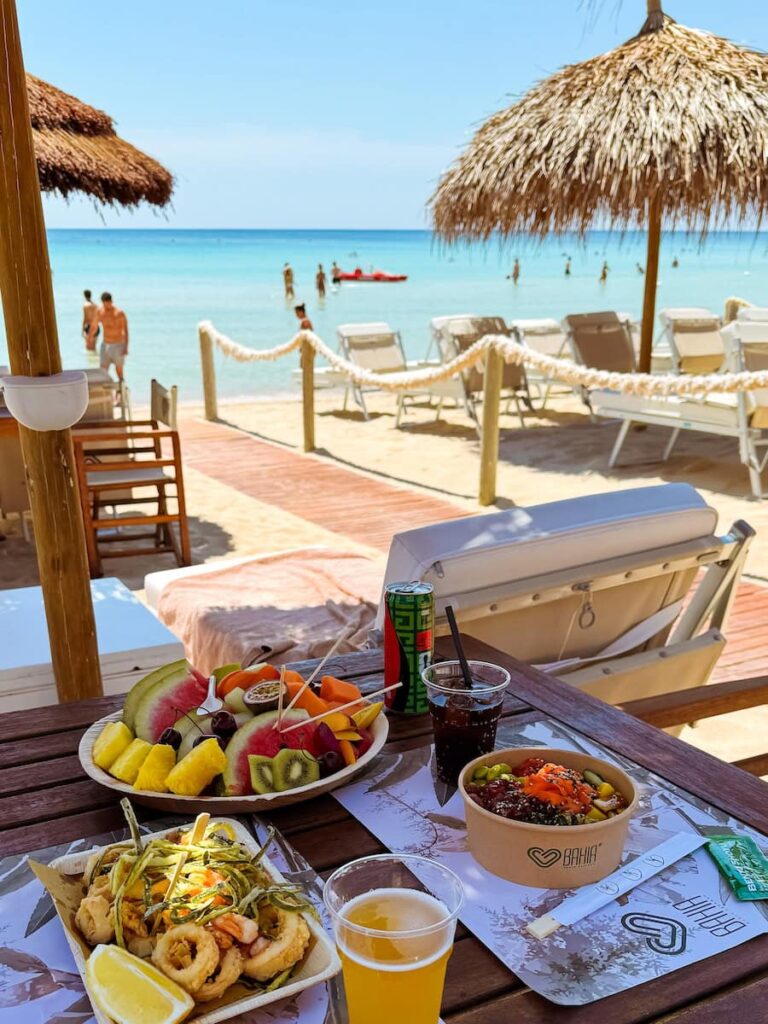
We wanted a relaxing beach day, so we started on the Ionian coast at Bahia Beach Club in Porto Cesareo, about 40 minutes from Lecce, where the water is impossibly clear and shallow, the kind of turquoise people don’t believe until they see your unedited photos. Book a daybed ahead in summer. (Punta Prosciutto, just up the coast, is an equally dreamy alternative with some of the finest sand in Italy.)
A note: beach clubs in Puglia are not cheap in the summer months. In summer months, premium setups can easily run more than 100 euros for two loungers and an umbrella, with prices climbing the closer you are to the water. If you’re watching the budget, the free public beaches nearby are just as beautiful, you’ll just need to bring your own towel and umbrella.
Afternoon Beach Time
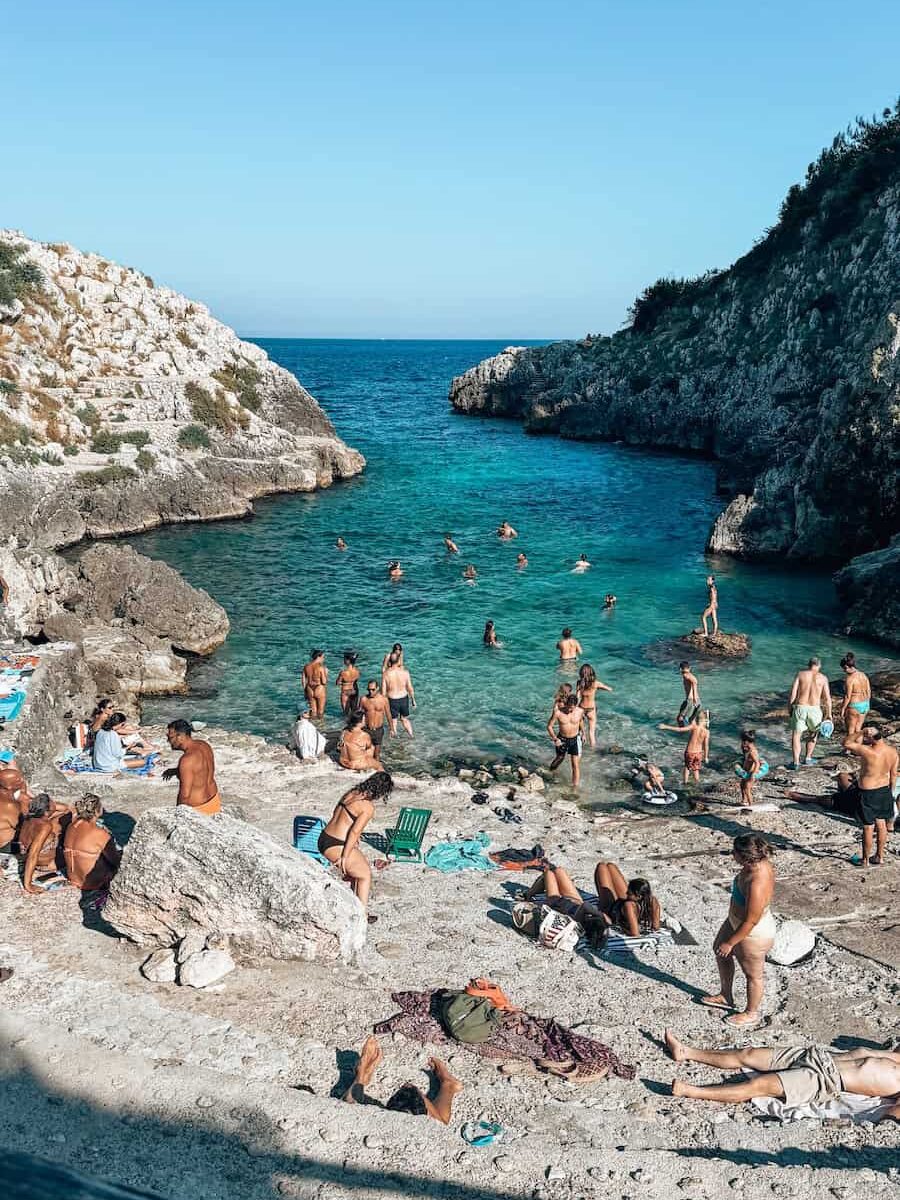
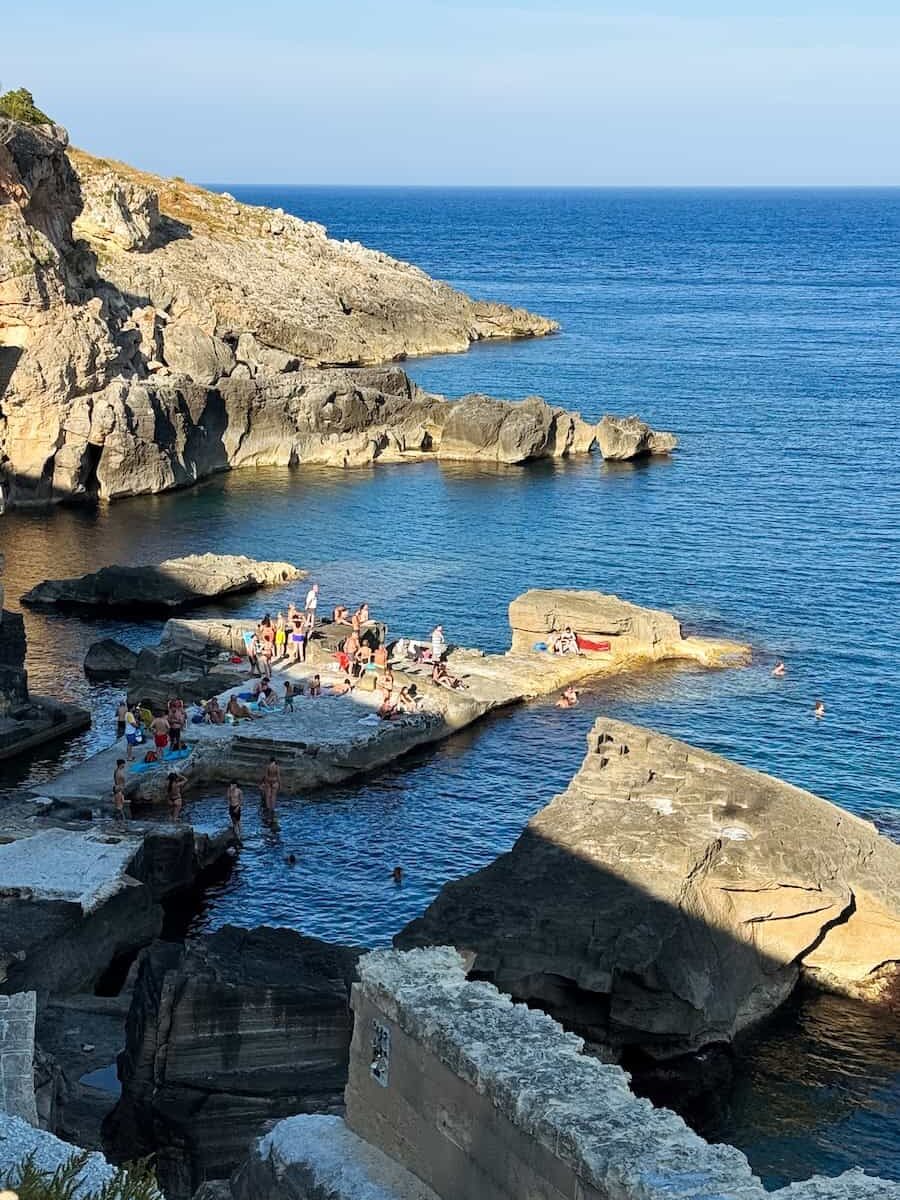
In the afternoon we crossed to the wilder Adriatic side to see the contrast. We visited Cala dell’Acquaviva, a narrow fjord-like inlet of deep green water tucked between cliffs and it was quite busy with locals.
We then drove to the rocky swimming spots in Santa Cesarea Terme, and finished the day with a swim in the waters.
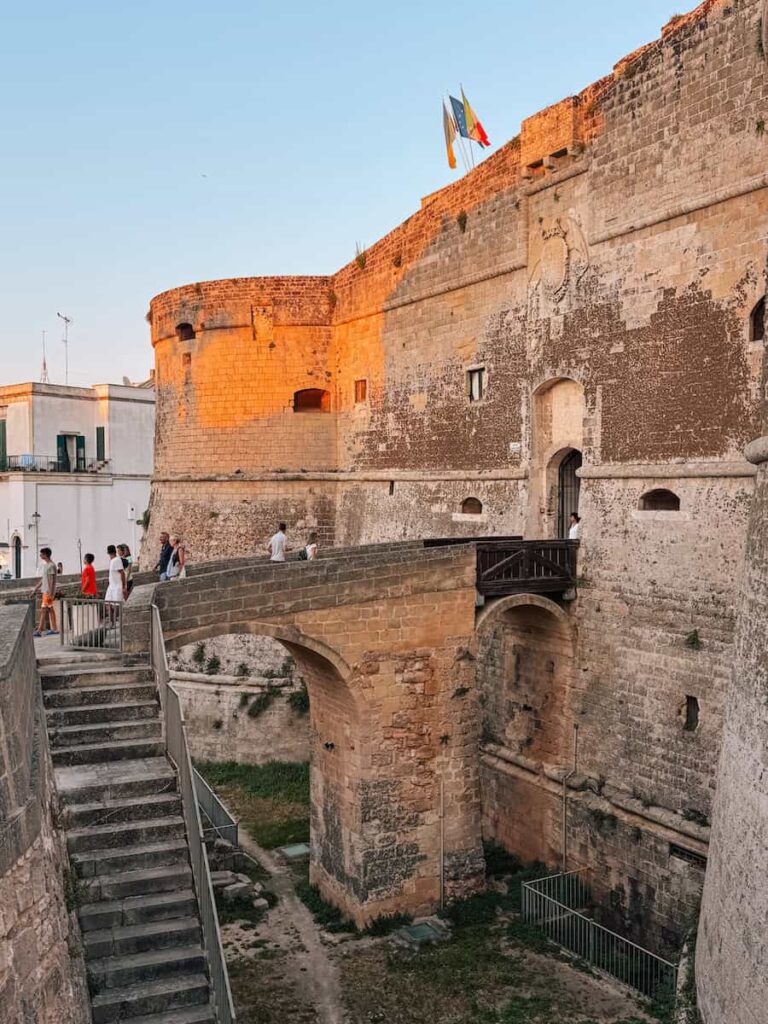
End the trip in Otranto, Italy’s easternmost town, for a farewell dinner. Arrive before sunset so you have enough light to wander: the walled old town is guarded by the imposing Aragonese Castle, and the Cathedral of Otranto hides one of Italy’s treasures, a remarkable 12th century floor mosaic that covers the entire nave.
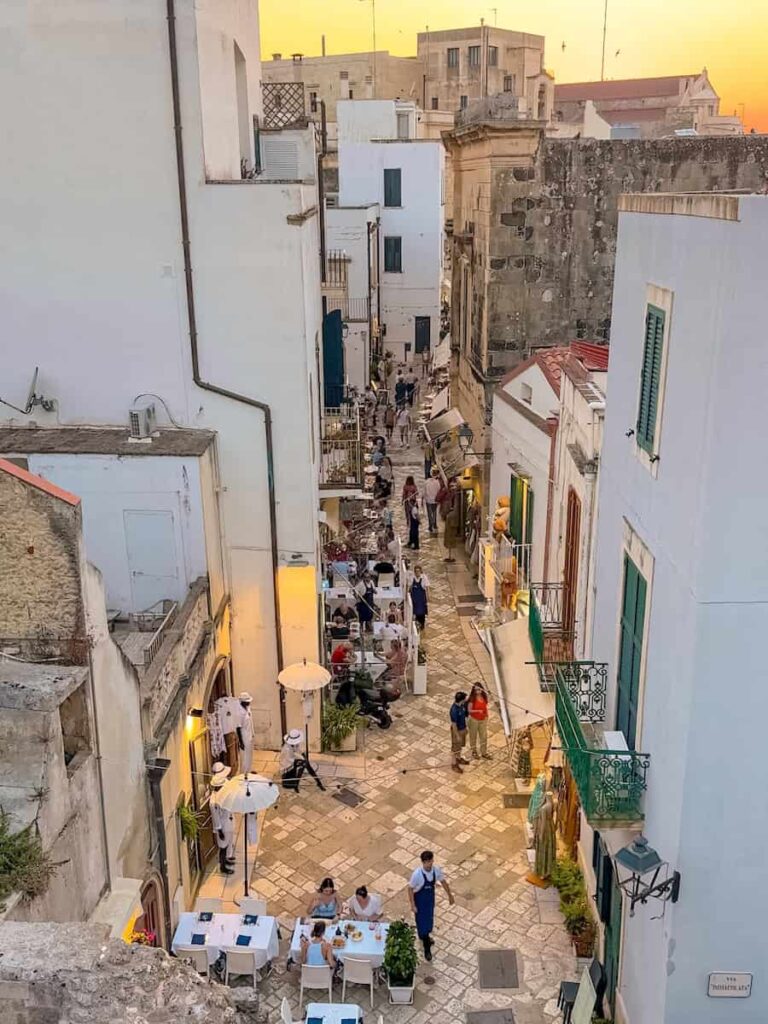
Then join the locals on the seafront promenade as the sky changes color over the harbor. The whitewashed old town and lungomare at dusk are the perfect final images of Puglia to take home.
An equally good version of this day if you are based in Lecce would be morning swim at Porto Cesareo or Punta Prosciutto, then an evening in Gallipoli, the island old town on the Ionian side, for sunset and dinner.
The next morning, Brindisi airport is only about 40 minutes from Lecce.
Ciao, Puglia!
The 5 Day Puglia Itinerary: If You’re Short On Time
With five days, don’t try to keep every stop and rush through faster. Cut a region instead, and here are my suggestions:
Option 1: Matera and the Valle d’Itria (fly in and out of Bari). My pick if it’s your first visit, since it keeps the two most extraordinary stops. This one is simple: follow days 1 through 5 of the main itinerary exactly, then fly home from Bari the next morning (about an hour’s drive from the valley).
Option 2: Valle d’Itria and the Salento (Bari in, Brindisi out). Skip Matera and trade it for Lecce and the beaches. Fly out of Brindisi the morning after day 5, about 40 minutes from Lecce.
The 10 Day Puglia Itinerary: How I Would Spend Three Extra Days
If I had ten days, here’s exactly how I’d stretch this route. I’ll be upfront: the additions are the places I ran out of time for, planned from a lot of research and firsthand recommendations rather than my own visit, and they are first on my list for the return trip.
What the extra time adds:
A second night in Matera. One night was enough to fall in love and not quite enough to see everything. A second day means the rock churches, the Murgia park viewpoint across the ravine (where you get the full panorama of the Sassi), and another sunrise.
Martina Franca, properly. The baroque grande dame of the Valle d’Itria, all ornate palazzi and elegant piazzas, and home to a famous summer opera festival. With an extra valley night it gets the full evening it deserves instead of a squeeze-in.
A boat or beach day. Either see Polignano’s sea caves from the water, the one perspective of Puglia the 7 day route misses, or spend a lazy day at the beach clubs of Savelletri and Torre Canne on the coast below the valley. Book this popular boat tour here.
Gallipoli. The old town sits on its own little island on the Ionian coast, ringed by walls and beaches. Pair it with a lazy afternoon at Punta della Suina or Baia Verde just south, and stay for the famous Ionian sunset.
Santa Maria di Leuca. The very tip of Italy’s heel, where the Adriatic meets the Ionian beneath a historic lighthouse. The coastal road between Otranto and Leuca is one of the most scenic drives in Italy.
Puglia Itinerary FAQ
Is 7 days enough for Puglia? Yes, for the highlights. This route covers Matera, the Valle d’Itria, the Adriatic coast towns, Lecce, and the Salento beaches at a pace that is brisk but never frantic. You’ll leave with a list for next time, which is exactly how Puglia should work.
Do you need a car in Puglia? Realistically, yes. Trains link the major towns, but the countryside masserias, the beaches, and villages like Cisternino require a car. Book early in summer through DiscoverCars: automatic transmissions sell out fast in Italy.
Should I stay in one base or move around? This itinerary uses three bases: one night in Matera, four in the Valle d’Itria, two in Lecce. That’s the sweet spot between seeing the region and living out of your suitcase. Puglia is long and thin, so a single base means hours of daily driving.
When is the best time to visit Puglia? May, June, September, and early October. We loved having warm-enough-to-swim weather without August’s chaos.
Is Matera really worth including in a Puglia itinerary? Without question. It was one of the most memorable stops of the entire week, and it’s barely an hour from Bari. Cross the regional border and go.
Final Thoughts
Before visiting Puglia, I already knew I was going to fall in love with the trulli, the beaches, and the beautiful boutique hotels. What I really fell in love with, though, was the pace of life and living la dolce vita.
Long breakfasts under olive trees and grape vines, quiet afternoons by the pool at our countryside masseria, wandering whitewashed streets with no particular destination, and lingering over dinner in a piazza with lively music.
That’s what makes Puglia so special. It isn’t a destination where you rush from sight to sight checking items off a list. It’s a place to slow down, embrace the rhythm of southern Italy, and leave room for spontaneous discoveries along the way.
I hope this 7 day itinerary helps you plan an unforgettable trip. If you end up following it, I’d love to hear about your experience, and if you have any questions while planning your journey, feel free to leave a comment below.
Check out my other Italy posts for inspiration!
-
Trulli Damari Review: A Dreamy Trullo Hotel in Puglia
-
Matera Travel Guide: 13 Best Things to Do in Matera, Italy
-
The Ultimate Puglia Itinerary: 5, 7 & 10 Day Road Trip Guide
-
One Day in Venice Itinerary You’ll Want to Steal
-
7 Day Tuscany Itinerary for an Unforgettable Trip
-
Siena, Italy: Perfect Mini Travel Guide
-
Ultimate Florence Travel Guide: Best Things to Do, Where to Stay and Day Trips (2026)
-
The Ultimate Cinque Terre Guide
-
Ultimate Venice Travel Guide: 13 Best Things to do in Venice and Where to Stay

Great information. Now I’m stay in Puglia for 25 days. We have so much info that we are very confused. And my wife wants to go everywhere. We are starting in Bari and have already booked a 2 nights in a hotel here. My question is: with this many days how many town stays would you think we should booked? Thank you. Best, D.
I’m so jealous that you have so many days in Puglia! I think starting with 2 nights in Bari is fine, add 2-3 to Matera, and then maybe 3 stays in the remaining 3 weeks? It sort of depends on what you want to see, and if you want to experience different hotels. If you’d rather not move bases too much then perhaps 3, but for someone like me who loves exploring new hotels, I might even see myself doing 4 or 5 within 20 days. Hope this helps!