

Complete Japan Train Travel Guide: Costs, Passes, and How to Book
Japan has one of the best train systems in the world. Trains are clean, punctual, easy to use, and cover almost every corner of the country.
However, the Japanese rail travel system is so vast it can be a bit overwhelming at first, and I admit I felt a bit stressed when first planning my trip. There were so many trains, different passes, and why was I getting a different website for each ticket I’m trying to book?!
Once you understand the basics though, getting around Japan becomes stress free even if it is your first trip.
In this blog post I’ll share different types of trains in Japan, how to book tickets, and ways to save money.
This post contains affiliate links. If you make a purchase using one of these links, I may receive compensation at no extra cost to you. Thank you for supporting my business so I can create content like this for you!
Overview of Japan’s Train System
Japan’s rail system looks complicated at first, but it is actually very well organized.
First, it’s important to understand that Japan’s railways are owned by multiple companies. 6 independent companies make up the JR (Japan Railways) Group, and there are smaller privately owned companies that operate some of the railways.
JR Trains
These trains operate nationwide and include local trains, limited express trains, and the Shinkansen bullet trains. JR lines connect major cities and are the backbone of long distance travel.
If you are traveling between cities like Tokyo, Kyoto, and Osaka, you will almost always be using JR trains.
Private Railways
Private railway companies operate many regional and city lines. These are common around Kyoto, Osaka, and Tokyo suburbs. They work the same way as JR trains but are run by different companies.
Types of Trains:
Now lets look at the specific types of trains:
- Shinkansen – known as bullet trains, these are the high-speed trains that are the fastest and most expensive. They cover major cities and longer distances so that you can explore all parts of Japan.
- Limited express – also serves major cities and they have fewer stops in between than regular trains.
- Express trains – there aren’t many of these left. These include specific airport transfers.
- Rapid trains – skips a few stops compared to local trains.
- Local trains – slowest, good for local travel and short distances.
- Other – character trains, luxury, scenic routes.
You can book Japan train tickets on Klook.com – use code MINYWANDER for a 10% discount on your train tickets!
Subways
Large cities like Tokyo and Osaka have extensive subway systems. The subway helps you move within a city, giving you access to tourist attractions and residential and business districts. These are best for short distances within the city and are usually the cheapest option for daily sightseeing.
✦ ✦ ✦
How Much Do Trains Cost in Japan
Subway & Local Trains
Subway, local and rapid trains are affordable and great for city travel. Subway tickets will vary based on cities.
In Tokyo, a single subway ride will cost between ¥180 to ¥220 Japanese Yen, or approximately $1.15 – 2.10 USD.
In Kyoto, you can expect ¥220 to ¥360, or $1.40 – $2.30.
*Note that all the USD calculations depend on the day’s exchange rate.
Limited Express Trains
Limited express trains are faster regional trains that require an extra fee.
A typical limited express ride might cost 1000 to 3000 yen depending on distance.
Shinkansen Bullet Trains
Shinkansen is Japan’s iconic bullet train. These trains are the most expensive but also the fastest and most comfortable.
Train prices depend on various factors including distance, train type, seat reservations, and seating class.
There are 3 classes on the shinkansen.
–Ordinary car (second class) – the standard class
–Green car (business class) – has more spacious seats
–Gran Class (first class) – only available on certain lines. Even more spacious and extra amenities.
Example prices one way (ordinary car prices)
Tokyo to Kyoto about ¥13,000 – ¥15,000 (approx. $83-$95 USD)
Tokyo to Osaka about ¥14,000 to ¥16,000 (approx. $90-$100 USD)
Regardless of the class, seats are spacious, luggage friendly, and trains run exactly on time.
JR Pass Explained
Many people have heard of the JR Pass and believe it to be the best money-saving way to ride trains in Japan.
This was true, up until a few years ago.
What the JR Pass Is
The JR Pass is a multi day pass that allows unlimited access on JR Group trains, buses, ferry services in Japan including most Shinkansen, for a fixed price.
It is available in 7, 14, 21 day options.
7 days: $323
14 days: $516
21 days: $645
The above are prices for one adult, in ordinary car (second class). Green car tickets will have an extra cost.
Who the JR Pass Makes Sense For
It can make sense if you are doing multiple long distance trips in a short time.
Why the JR Pass Often Does Not Make Sense Anymore
In October 2023 there was a massive price increase of the JR Pass resulting in a 70% increase, so I find that it almost is never worth it anymore.
For most typical itineraries like Tokyo-Kyoto-Osaka, buying individual tickets is now much cheaper than using the JR Pass, so skipping the JR Pass saves money.
If you want to compare the prices of buying individual tickets versus using the JR Pass, there are 2 good tools you can use:
https://www.japan-guide.com/railpass/
https://japantravel.navitime.com/en/area/jp/route/calculator/
You can enter your travel details on this site and it will give you a price comparison of JR Pass vs purchasing individual tickets, or purchasing regional passes. For this to be the most accurate, you want to have your ENTIRE trip itinerary and enter all the trains you plan on taking.
Check out these unique experiences in Japan!
IC Cards Explained
IC cards are rechargeable cards for paying transportation fares in Japan.
They can also be used at many vending machines, shops and restaurants. To use, simply touch the card on a reader.
There are 3 major IC cards: Suica, Pasmo, and Icoca. They are named by region issued in, but have the same function and you can use it across the country.
Tip: If you have an iPhone, you can get an IC card on your phone and use digitally. Go to your Wallet app – Add to Wallet – Transit Card – scroll down to Japan where you can add any one of the 3 cards. You can tap your phone to use and reload the balance right on your phone.
How IC Cards Work
You load money onto the card and tap in and out of stations. The correct fare is automatically deducted.
They work on JR trains, private railways, subways, and even buses. You can also use them at vending machines and convenience stores.
Where to Get Them
You can buy them at airport stations or major train stations. Digital versions are also available on iPhone wallets and you can reload using a credit or debit card on your phone.
When to Use Them
Use IC cards for all local travel and short distances. They save time and eliminate the need to buy tickets constantly, or the need to use physical ticket machines each time.
✦ ✦ ✦
How to Book Japan Train Tickets
Now let’s look at how to actually book train tickets in Japan.
There’s no need to pre-book Japan’s local trains, subway, buses or taxi.
For these the easiest way to purchase tickets or fare are to pay with your IC card as mentioned above.
But you should consider pre-purchasing shinkansen or long-distance trains.
When to Book in Advance
Shinkansen (bullet train) tickets should be booked in advance during peak seasons like cherry blossoms season and fall foliage.
Airport trains are also best booked ahead if you want reserved seating (we had to stand with our luggage last time and it was not fun!).
Where to Book
For tourists, the easiest option is booking online through platforms that accept foreign cards and provide English support.
Remember how we talked about JR (Japan Railways) Group being made up of 6 independent companies? That being said, each company (JR East, JR Central, JR West, JR Shikoku, JR Kyushu, JR Hokkaido) has its own booking system and this can be very confusing.
I tried booking my tickets through some of their websites, and it was difficult due to the language barrier and inconvenient having to pick up physical tickets on designated dates prior to the trip for some companies.
Also, certain types of credit cards were not accepted on the Japanese websites.
The easiest way to book your train tickets will be through Klook, an online platform that allows travelers to book a wide range of activities, services, and experiences in destinations around the world.
Benefits of booking on Klook is that it is all in English as well as other non-Japanese languages, and it is easy to use. You simply enter your starting point and destination, and your date.
Once you make your purchase, you can board trains using a QR code rather than having to pick up physical tickets. Klook does add a small fee to book on their website, but I still found it easier to use and worth paying the fee than to navigate the JR websites.
To make this even better, you can use code MINYWANDER for 10% off your booking (3% if you are an existing Klook user).
You can book:
Shinkansen tickets between major cities, with sear reservations
Airport trains to Tokyo: Narita Express or Keisei Skyliner
Airport trains to Osaka: Nankai Limited Express or Haruka
Regional rail passes such as JR West Kansai Pass (for Kyoto, Osaka, Kobe, Nara and more)
Booking ahead saves time, avoids ticket machine stress, and guarantees seats during busy travel periods.
Regional and Local Train Passes in Japan
If you are traveling within one region of Japan, regional and local passes can save you money without the high cost of a nationwide pass (JR Pass).
What Are Regional Train Passes
Regional passes offer unlimited travel within a specific area for a fixed number of days. They are usually run by JR regional companies or local rail operators.
When Regional Passes Make Sense
They are worth considering if:
You are based in one region for several days
You plan multiple day trips from one city
You are not traveling long distances like Tokyo to Hiroshima
Popular Regional Pass Examples
Kansai region passes for Kyoto Osaka Nara Kobe
Tokyo area passes are useful for Nikko, Lake Kawaguchi
JR East Tohoku Area passes for areas around Tokyo, Sendai, Aomori, Akita
Kyushu Rail Pass for southern Japan travel
These often include unlimited rides plus discounts on attractions.
Local and City Passes
City passes focus on short distance travel and sightseeing.
They usually include:
Unlimited subway and bus rides
Sometimes free or discounted entry to attractions
Examples include:
Tokyo subway day passes (I get this every time I go to Tokyo!)
Tokyo activities pass – choose # of activities
Osaka metro passes
These are best for heavy sightseeing days when you plan to hop between neighborhoods frequently.
When Local Passes Are Not Worth It
If you only plan two or three rides in a day, paying per ride with an IC card is usually cheaper and more flexible. It’s fairly easy to calculate if you’ll be saving money or not so do the math, and get what works best for you!
How to Decide Between Individual Tickets and Passes
Add up the estimated cost of individual rides first.
If the pass costs less and matches your itinerary exactly, it is worth it.
If not, stick with individual tickets and an IC card.
This approach prevents overpaying and keeps your plans flexible.
Remember to use these Japan rail pass calculator compare prices between individual tickets and regional passes, or the JR Pass:
https://www.japan-guide.com/railpass/
https://japantravel.navitime.com/en/area/jp/route/calculator/
Example Japan Train Budget
Here is a realistic sample itinerary (my 2 week Japan itinerary) and how much it cost me, versus what it would have cost me with a JR Pass.
My 2 week Japan Itinerary:
Tokyo – Kawaguchiko (Mount Fuji) – Kanazawa – Kyoto – Nara – Osaka
Tokyo – Kawaguchiko (Mt. Fuji): $29.30
Kawaguchiko – Tokyo Station – Kanazawa: $14.58 (highway bus) + $100.48 (
| From – To | Route | Cost | Included in JR Pass? |
| Haneda airport to hotel | Airport limousine | $9 | No |
| Tokyo Subway Pass (72 hr) | Subway | $9 | No |
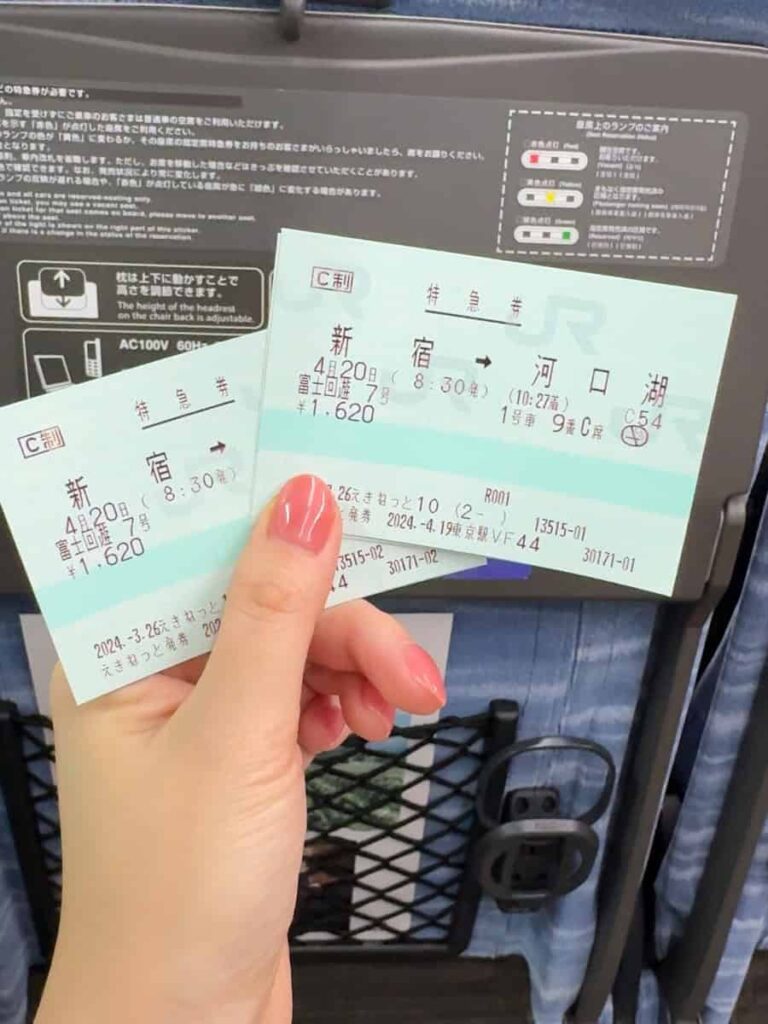
| Tokyo – Kawaguchiko (Mount Fuji) | Fuji Excursion train | $30 | Partial – need to pay $11 extra |
| Kawaguchiko – Tokyo Station | Highway Bus | $15 | No |
| Tokyo Station – Kanazawa | Hokuriku Shinkansen (w seat reservation) | $100 | Yes |
| Kanazawa – Shirakawago | Bus | $17 | No |
| Shirakawago – Takayama | Bus | $17 | No |
| Takayama – Kyoto | Limited Express + Shinkansen | $74 | Yes |
| Kyoto – Nara (round trip) | Limited Express | $15 | Yes |
| Kyoto – Osaka | Special Rapid | $4 | Yes |
| Haruka Express to Kansai airport | Haruka Express | $11 | Yes |
| Total Spent: $301 | Total: $501+78 = 579 |
So as you can see, I spent about $301 for transportation during my 2 week trip to Japan. We did spend some more on local buses, but this would not be included in the JR Pass anyways.
If I had gotten the 14 day JR Pass, that would have cost me $516, and would have had to pay for the buses and airport limousine, bringing the total to $579.
So I saved about $278 (per person!) by not getting the JR Pass.
Tips for Japanese Trains
Consider Regional or Local Passes
Regional passes can be cheaper than nationwide passes if you are staying within one area.
Use Luggage Forwarding
If you have a lot of luggage, sending luggage between hotels lets you travel light and avoid oversized baggage fees on trains. This also makes local trains more comfortable. Most hotel front desks will do this for you. Simply take your luggage to the reception desk a night before your departure to the next city. I forwarded my large suitcases so that I only had to travel with my small carry-on size luggage at the stations.
Don’t forget your Ekiben!
Ekiben are Japanese boxed lunches sold at train stations. It combines the words “eki” (station) and “bento” (lunch box). Depending on the region and station, you’ll find different menus and there’s even boxes that heats up without a microwave!
Google Maps
Google Maps does a great job of showing you the trains you need to take, and where to take them such as what platform.
FAQ Section
Do I Need to Book Trains in Advance
Only Shinkansen and airport trains during busy seasons. Local trains never require advance booking.
Is the JR Pass Worth It
For most travelers, no. Individual tickets are usually cheaper unless you are covering very long distances in a short time.
Are Trains Expensive in Japan
They are efficient and fairly priced for the quality. With smart planning, train travel is not as expensive as many people expect.
Final Thoughts on the Japan Train Travel Guide
I hope this has helped you plan your trip to Japan! Once you get the hang of it, it’s so easy to travel within Japan due to its well connected rail network. Don’t forget to check out my other guides for Japan below!
Tokyo Travel Guide – Best Things to do in Tokyo
The Ultimate 3-Day Kyoto Itinerary
How to get from Tokyo to Lake Kawaguchiko for Mount Fuji
Hotel Review: Hyatt Centric Ginza Tokyo (Japan)
USE MY CHECKLIST TO PLAN YOUR TRIP!
- Flights
- Search for the best flights on Skyscanner to get to your destination
- Search for the best flights on Skyscanner to get to your destination
- Hotels
- I use Booking.com for most accommodations
- For Asia, I prefer Agoda as they have the most competitive prices. I also compare prices on Klook (you can use my code MINYWANDER for a discount so see if that’s a better deal)
- For vacation rentals, especially for larger families, consider VRBO
- Transportation
- Trains & Ferries – book on Omio
- Rental Cars – I usually book on DiscoverCars
- For reliable airport pickups, use Welcome Pickups
- For Asia I use Klook (code MINYWANDER for a discount) – Japan trains for example
- Activities & Tours
- GetYourGuide and Viator are my go to’s.
- For Asia, I prefer Klook as there are more options – use code MINYWANDER
- E-sim
- Stay connected with Airalo E-sims.




One Comment